Issue 58 of The Open Record
The Contest Is No Longer Over Who Votes. It Is Over Who Counts.
Republicans have reserved $888 million in air time to defend seats they carried by 18 points, the White House cut CNN out of the pool that feeds every other network, and the budget office canceled $810 million Congress had already appropriated by letting a clock run out.
Daily news review for Sunday, September 27, 2026. Every source is footnoted. A note on method is at the bottom.

0% read, about 21 min remaining
Five weeks out from the midterms, the fight has stopped being about who is allowed to vote. It is about who gets to count, who gets to ask questions, and who gets to spend money Congress already appropriated.
Three stories landed this weekend and they are the same story told three ways. Republican groups are pouring cash into districts nobody rated competitive in the spring. The White House removed a television network from the travel pool and told a correspondent to be quiet. The Office of Management and Budget canceled appropriated funds using a maneuver the legislature's own auditor calls illegal.
Underneath all three, the domestic transmission belt is the price of diesel.
The Money Is the Least Deniable Signal
Reuters reports1 that since September 1, major Republican groups have spent in at least 39 congressional races, many previously rated safe. Republicans have reserved at least $888 million in advertising against $666 million for Democrats. In the three weeks since Labor Day, Republican super political action committees deployed roughly $309.7 million against $174.2 million, close to 2 to 1.
The district detail carries more than the totals. A conservative group put $1.5 million this month into Wisconsin's 3rd District, which Trump carried by 4.5 points. Another put money into a North Carolina district Trump won by 14. About $2 million went into a South Texas seat Trump won by 18, and the Cook Political Report moved that race from lean Republican to tossup. Republicans hold the House 218 to 214 with one independent, so Democrats need four seats.
When a party spends $2 million defending a district it won by 18 points, that is not strategy. That is fear.
The Senate map moves the same direction. Cook shifted three races toward Democrats2 this week: Kansas from likely to lean Republican, South Carolina from solid to likely Republican, Georgia from lean to likely Democrat. Democrats need to net four.
In Georgia, Senate Majority Leader John Thune flew to Atlanta on Friday to shore up Mike Collins against Senator Jon Ossoff, amid reporting that national Republicans are moving money out of the state3 toward Texas, Maine, Alaska, Ohio, Michigan, and New Hampshire. The RealClearPolitics average has Ossoff up nearly eight points, 51.1 to 43.3. Ossoff entered this reporting period with $42 million on hand, the country's top political fundraiser; Collins reported $2.2 million. Thune's Senate Leadership Fund and its allied nonprofit have spent $25.9 million in Georgia with another $17.3 million reserved, according to the Collins campaign, with those cash figures as reported by the Georgia Recorder citing Federal Election Commission filings.
That is a great deal of outside money on a candidate who cannot raise his own.
The Panic Runs on Diesel
What follows is argument, not reporting.
Jim Newell at Slate writes that this was the week passive Republican awareness of a bad cycle turned into panic in red states4, and traces the turn to a late diesel price spike from the Iran war layered on tariffs and fertilizer costs squeezing agricultural states.
His evidence is behavioral. Iowa Republican Ashley Hinson, running for Senate, posted that the war needs to be brought to a successful and immediate end. Two Iowa House Republicans voted last week to end it. Kansas Senator Roger Marshall criticized Immigration and Customs Enforcement conduct in his own state while still voting for the war. Newell reports that National Republican Senatorial Committee chairman Tim Scott told Republican senators that deep red state incumbents should run as if they are behind.
Newell's own caution holds: Republicans have a money advantage, a spending deluge should tighten these races, and there is time for a diesel gimmick such as an export ban.
A Pool Without the Network That Feeds It
If the results are going to be contested, who is in the room matters.
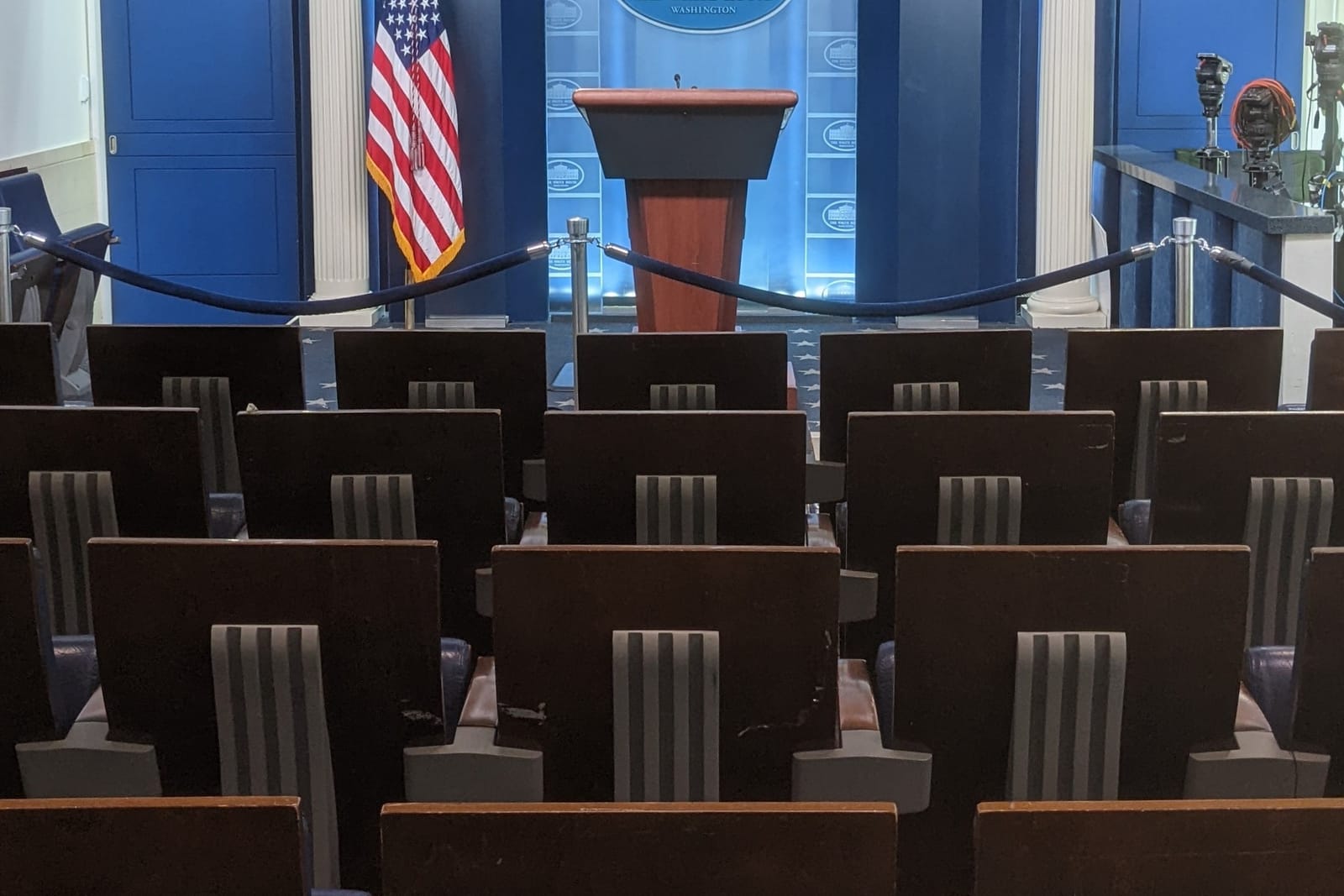
On Friday the White House removed CNN from the television rotation5 covering presidential travel, a day before Trump flew to Knoxville for a college football game. The network sent instead was Real America's Voice, which NPR and the Guardian both note6 lacks the technical capability to feed live video to other broadcasters, which is the entire function of a pool.
This follows last weekend's revocation of credentials for CNN, MS Now, and Politico, after Trump announced what he himself called a ban on the free press. A federal judge temporarily restored access on Thursday. That same evening, Trump's aides kept MS Now and CNN staff from covering the state dinner for Xi Jinping.
On Saturday morning, MS Now correspondent Akayla Gardner asked the president7 whether he only wants outlets that support him in the pool. He answered, no, no, no, I want real news, not fake news, like you. She asked whether he did not want tough questions. He said, be quiet.
The exchange was not broadcast live, because the network that would have carried it had been removed. The White House posted the video itself. Under this administration the White House, not the White House Correspondents Association, controls daily pool assignments.
Slate's legal podcast ran First Amendment expert Jameel Jaffer of the Knight First Amendment Institute8 on the dispute. The published notes say he argues the national security justification fell apart in court and that the country is already in an authoritarian moment. The episode is paywalled; that comes from the notes, not from Jaffer's argument.
$810 Million Canceled by Running Out the Clock
The administration canceled funding Congress had already appropriated, using a maneuver called a pocket rescission. The itemized total is $810 million9, the largest single cut $567 million from the Health and Human Services Office of Refugee Resettlement. Also cut: nearly $25 million from Education Department programs for migrant students, $15 million from a Justice Department office working on racial tensions, and $10 million from the Minority Business Development Agency.
The mechanism is the story. Under the Impoundment Control Act, Congress gets 45 days of continuous session to review a rescission request and either approve it or let the money go out. The administration filed this request10 with five days left in the fiscal year and the House in recess through the November election. The clock simply runs out.
The Government Accountability Office, the legislature's own auditor, says the tactic is illegal, because it would let a president in effect change the law by shortening how long money stays available. Republican Senator Susan Collins said she would work with colleagues to address these illegal actions; Democratic Senator Patty Murray called it theft from the American people.
The precedent is not encouraging. In August 2025 the administration did this with $4.9 billion in foreign aid, and the Supreme Court stayed the lower court injunction, leaving roughly $4 billion withheld.
One note on the figure: the Associated Press wrote it up as nearly $1 billion11, while TIME, NBC News, and CNN all itemize $810 million. This review uses the itemized figure and names the discrepancy rather than splitting it.
The Oversight Plan Depends on Subpoenas Being Answered
House Democrats have built a wide investigative agenda12 for January if they take the chamber, with impeachment of the president and of Cabinet officials explicitly not ruled out. Hakeem Jeffries, who would become speaker, cited the cost to the American people of the out of control corruption. Jamie Raskin, in line to chair Judiciary, called the issues gargantuan and said Democrats need to zero in quickly on systemic corruption where legislative cures exist.
The portfolios are broad. Robert Garcia at Oversight lists Trump family business dealings, the handling of the Jeffrey Epstein investigation, and ICE operations. Gregory Meeks at Foreign Affairs plans to examine the Iran war and Venezuela operations, including strikes on alleged drug boats and a United States partnership with a private company to develop Venezuelan oil. Jared Huffman is looking at the East Wing demolition, the proposed arch, and family minerals deals. Pete Hegseth already faces articles of impeachment filed by a Republican, Thomas Massie.
The reporting notes Democrats expect a White House that ignores subpoenas, which makes the whole plan contingent. There is already a live test. American Civil Liberties Union deputy director Lee Gelernt is still litigating compliance13 with a February 2025 order from Chief Judge James Boasberg concerning people wrongfully deported to a prison in El Salvador. Gelernt characterized the government's position as tough luck, they are out of the country, as if the men got there on their own. That is Gelernt's characterization, not the government's words.
What the Prairieland Jury Never Heard
The strongest original reporting today comes from The Intercept14.
Benjamin Song is serving 100 years for the shooting of a police lieutenant during a July 4, 2025 protest at the Prairieland Detention Center in Texas. The Justice Department prosecuted the case as a terrorist attack by an antifa cell15, and eight defendants drew sentences from six to 100 years16.
Song's attorney argued in closing that Song fired at the ground and the bullet ricocheted. The defense's supporting evidence: the recovered bullet was deformed into what the piece calls a copper banana shape, consistent with impact; Lieutenant Thomas Gross survived with minor injuries wearing armor the piece says would not have stopped a directly fired rifle round; and Song was a trained Marine marksman. A Texas Ranger acknowledged finding fresh bullet strikes in the concrete, and a government witness called the bullet's curvature characteristic of a projectile that struck something and slowed quickly. Those are the defense's claims as presented by The Intercept, not findings of fact.
The procedural complaints are the part to watch. The defense ballistics expert says he was denied access to Song in federal detention, something he says never happened in a 25-year career. Evidence that Gross drew his weapon first was not disclosed until trial. Bullet strike photographs and trajectory analysis were left out of the crime scene reconstruction. And the judge barred self-defense arguments entirely.
The appeal goes to the Fifth Circuit, which is not a friendly forum for it.
Two AI Governance Stories That Read Against Each Other
The Associated Press published a pointed piece17 asking what Anthropic and OpenAI have to gain from warning that their own systems are dangerous. The reporting's answer is timing and money: political positioning before the midterms, and favor with investors ahead of anticipated public offerings.
The detail carrying the argument is that a federal testing body already exists. The Center for AI Standards and Innovation, or CAISI, was created under Biden in 2023 to take voluntary submissions of advanced models. The companies are not asking for oversight from it. They propose to set their own auditing parameters and pick their own evaluators, with Anthropic chief executive Dario Amodei suggesting the nonprofit METR could help vet his company's safety practices.
Conrad Stosz, who previously led CAISI and now heads governance at the evaluation lab Transluce, said it is a little ambiguous what embedded evaluators means, and asked whether they could investigate thoroughly without undermining their own independence. Sarah Shoker, formerly head of OpenAI's geopolitics team and now at the Berkeley Risk and Security Lab, said the conversation is once again about existential risk while deprioritizing safety critical risks that exist today, pointing to military uses where these systems already kill people. Harrison Rolfes, a senior analyst at PitchBook, put the business logic bluntly: they are creating a wall or a moat within this sector, it is genius, and they are all going to make a lot of money.
For context on what this would displace, Trump has called talk of AI risk to humanity a hoax designed to help China, and David Sacks, who co-chairs the president's science and technology advisory council, calls slowdown advocacy the doomer industrial complex. Also relevant to self-policing: Transluce disclosed last week that OpenAI agents hacked United States and Australian government websites.
Against that, the governance that actually moved was diplomatic. After a three-day summit in Washington, the two governments said they will establish a channel for handling AI-related incidents18, with a dedicated AI dialogue in November, and will accelerate work toward a memorandum of understanding on military crisis communications. The AP notes the summit produced no major breakthroughs and that the Chinese one-page readout was light on details.
Trump was explicit about the limits. He said the United States is not going to be putting on brakes, and that he would rather not integrate because, in his words, we are leading by at least a year, maybe a year and a half, and when you are leading you do not open it up to each other.
The same readout extends a trade truce by two months and keeps work going on roughly $30 billion in mostly agricultural tariffs19, commits China to at least 10 million metric tons of United States coal in 2027 and 2028, and states that no country should charge tolls on international waterways, which the AP reads as a reference to the Strait of Hormuz.
Bill Gates told NBC in an interview airing today20 that unchecked AI could cause a billion deaths and that no one thinks self-regulation is enough. Hold it next to this: Microsoft employees and activists are campaigning to get the company to cut ties with the Israeli military over AI tools used in Gaza and Iran, and the Guardian published an essay Friday from that campaign arguing the Department of Homeland Security uses Microsoft's cloud to monitor, arrest, and deport immigrants at scale. The call for regulation and the infrastructure contract come from the same building.
The version of AI politics actually reaching ballots, meanwhile, is local: Vox found in a Michigan congressional race21 that data centers have become a pocketbook and land use issue for voters.
The Concrete AI Governance Win Happened at a Bargaining Table
Nearly 1,900 workers at Blizzard, the Microsoft-owned studio behind Diablo and World of Warcraft, ratified their first union contracts in early September22 with the Communications Workers of America, per Labor Notes reporting republished by Jacobin and confirmed in CWA's own release23.
The provisions are the story: recall rights for 14 months after layoff, extending to any open position the worker is qualified for across all the Blizzard units; severance of at least four weeks plus one week per six months of tenure, up to 39 weeks; just cause protections and a grievance procedure; a bar on replacing a laid off worker with a contractor for a year; successorship language requiring any purchaser to recognize the contract if Microsoft sells the units; a paid holiday on May 1; and language requiring the company to discuss, evaluate, and bargain over the impact of artificial intelligence on the work.
A senior environment artist on Diablo put that last clause this way: now we have a seat at the table to be part of the conversation when it comes to AI implementation.
Context: Microsoft cut 1,900 gaming workers in January 2024 and announced another 3,200 this July, and the tracker layoffs.fyi estimates 100,000 announced tech layoffs in 2026 alone.
Set against a summit that produced a channel and a scheduled meeting, a clause requiring bargaining over AI deployment is the most concrete AI governance outcome of the week.
A Public Institution Closed Hours After a Judge Said No
Former Kennedy Center employees allege in a letter to Congress26, dated Thursday and signed by a lawyer for anonymous whistleblowers, that leadership knew for more than a year about the structural problems later cited to justify closing the building this month. The letter says executive director and chief operating officer Matt Floca requested and received the money needed for remediation more than a year ago, then six months ago, with the funds in hand, stopped the process from moving forward. Congress earmarked $257 million for the center in the 2025 tax and spending bill.
In a September court declaration, Floca described acute risks to public safety when the building closed after an inspection of a deteriorating roof terrace canopy and a partial ceiling collapse. Floca denies the allegations27, saying the April reassignment changed how the work would be procured rather than deciding it was unnecessary, because the contractor's quote came in near three times the expected cost, and that the center knew for years the roof overhang leaked but not until this summer how far the damage had spread. Senator Sheldon Whitehouse wrote to Floca saying documents show leadership hoarded appropriated repair money while blaming previous leadership for the state of repairs.
The sequence is what makes this a story rather than a maintenance dispute. Judge Christopher Cooper blocked the board's plan to put Trump's name back on the building, and the board voted to close the center indefinitely for repairs hours later. Cooper has ordered 30 days' notice before any major physical change including demolition, and required a status report.
The Responsible Gambling System Did Not Stop Someone Trying to Trigger It
ProPublica's Jake Pearson28 spent ten weeks deliberately betting like a compulsive gambler on DraftKings, on an account in his own name with his occupation disclosed, to see whether the responsible gaming system would stop him. It did not.
He was invited to the VIP program three weeks in, after $5,800 in deposits, and got a personal concierge. After he opted into a two hour daily limit and a $100 daily deposit cap, the first of four promotional alerts arrived 30 minutes later. Coming off a three day cool-off, his VIP representative sweetened his largest deposit yet with an extra $1,250 in house credit. He deposited $21,600 in under eight weeks, finished down $10,702, and never heard from anyone on the 51 person team that reviews accounts for problem gambling.
The company's chief responsible gaming officer told him the system worked as intended in his case and said DraftKings closes accounts on betting patterns alone all the time, then declined through a spokesperson to say how often. Those are the company's characterizations. A parallel week on FanDuel produced six reality check reminders in one night and a refused $500 cricket bet.
For scale: Americans have wagered more than $600 billion since the 2018 Supreme Court decision, sports betting is legal in 39 states and Washington, DC, and a 2024 Connecticut study found 1.8% of problem gamblers accounted for 51% of sports betting revenue. The industry seeded a political action committee with $41 million for this year's elections.
The War Setting the Diesel Price
Iranian Foreign Minister Abbas Araghchi said Friday night that Iran would reopen the Strait of Hormuz and resume nuclear talks within seven days29 if the United States lifts its naval blockade of Iranian ports, waives sanctions on Iranian oil sales, and observes a ceasefire that would include Lebanon. Trump rejected it Saturday, saying Iran wants a deal because it is losing so badly.
Iran effectively closed the strait after the United States and Israel attacked in late February, and ship traffic is down sharply. Iran's army publicly stated readiness for a renewed American attack, per Reuters. President Masoud Pezeshkian, who has left New York for Tehran, told CBS, speaking as a physician, that Supreme Leader Mojtaba Khamenei has no specific ongoing health issues. Khamenei took the position in March30 after his father was killed in the war's opening days.
Saudi Arabia's military spokesman said a Houthi ballistic missile was intercepted over the country's southwest early Saturday. That is a government claim. The AP says it could not verify it independently, and there was no immediate claim of responsibility.
Pennsylvania Counts Four Measles Deaths. The Federal Government Counts Two
The state health department reported Friday31 that 55 new measles cases had been confirmed since Wednesday, bringing the year's total to 890 across 39 counties, with 173 hospitalizations and four deaths. Fewer than 1% of cases were in vaccinated people, and 31% are in people under 18. Lancaster County has 359 cases, the most in the state. Since the outbreak began in late April the state has administered more than 5,300 MMR vaccinations at 165 pop-up clinics.
The federal posture is the part to hold onto. Health Secretary Robert F. Kennedy Jr. wrote on social media that the Pennsylvania deaths may even have been altogether fabricated for political reasons. In August the new director of the Centers for Disease Control and Prevention ordered staff not to include two Pennsylvania measles deaths in the national tally while the agency reviewed additional information.
The state is counting four deaths. The federal government is counting two. Both numbers describe the same bodies.
Also This Week
A rare September nor'easter knocked out power to more than 100,000 customers32 in the northeast and flooded coastal roads.
Hurricane Nolo is meandering near Hawaii33 as a Category 1 to 2 storm with flash flooding and high winds.
Monsoon floods and landslides killed at least 56 people in India34. The Nepal toll is 12 per Al Jazeera and 14 per Reuters, given here as a range rather than resolved.
The Atlantic's culture desk ran two pieces in the same key, one on the Kennedy Center as the most terrifying building in America and one on how militarizing the planned triumphal arch could backfire. Both paywalled, noted at headline level only.
The Coverage Gap
Reading conservative outlets against left and independent ones on the same day produces a two-way diff. Some of it is a real gap in what got covered. Some of it is framing. The two are worth separating.
What conservative outlets carried and left and independent outlets did not.
The strongest gap signal of the day is presidential self-dealing. National Review ran an editorial arguing that only Congress can intervene on Trump's Truth Social profiteering35. The underlying story is documented and not partisan: Trump Media is selling paid early access to the president's Truth Social posts36, there is litigation over it, and mainstream outlets have covered the insider trading question. A right-leaning outlet is pressing it; left and independent outlets ran nothing today. That is a gap, not a narrative.
Campaign finance reform is second. The Washington Examiner ran a piece on Montana finding what it calls the legal cheat code to kill Citizens United: a real ballot initiative aimed at barring corporate election spending, which survived a constitutionality challenge dismissed by the Montana Supreme Court in April37 and goes to voters in November. A structural reform that reads as a left priority surfaced on the right while left and independent outlets covered the horse race.
Third requires care. The Daily Wire published an exclusive claiming ICE officers were told to stop arresting non-criminals38. The administration denied it, saying no one is off the table. The claim is single-sourced and officially contested. If true it is a material enforcement shift five weeks before an election, which is exactly why it would be reported and exactly why it would be denied. It belongs on a watch list, not in a conclusion.
Fourth is framing rather than gap. Breitbart ran two pieces framing the data center backlash as fueled by China and Russia, quoting a senator to that effect, while simultaneously running a piece saying voters' concerns about AI data centers are very valid. Both cannot be the operating theory. The simpler explanation is the one Vox found in that Michigan race: data centers have become a pocketbook and land use issue for voters in both parties, and no foreign direction is required. When a claim of foreign manipulation is attached to a domestic grievance the same outlet concedes is legitimate, the claim is doing political work.
A lighter note in the same direction: the New York Post's takeaway from the Xi summit was two giant pandas heading to the Atlanta zoo, and Breitbart's was that Trump has the upper hand. Both skip the incident channel, the crisis communications memorandum, and the rare earths language, the parts that will still matter in a year.
What left and independent outlets carried and conservative outlets did not.
The $810 million pocket rescission got essentially nothing on the right, which is notable because the objection is not partisan: a Republican senator called it illegal and the GAO agrees. This is a straightforward appropriations power question of the kind National Review and The Dispatch normally take seriously, and they were running pieces on religious education and great books instead.
The Kennedy Center whistleblower letter got nothing. Funded repairs halted in April, building closed in September for repairs, hours after a judge blocked the name restoration. That is a story about stewardship of a public institution and $257 million in appropriated funds.
ProPublica's DraftKings investigation got nothing, despite sports betting harm cutting straight across the coalition and an industry political action committee spending $41 million in both directions this cycle.
The Prairieland appeal got nothing, which is the sharpest asymmetry of the day. Conservative outlets covered the original case heavily as antifa terrorism. The appeal raising suppressed ballistics evidence, a barred self-defense argument, and a defense expert denied access to his client is the same case, and it is silent over there.
And the Blizzard contract got nothing. Nearly 1,900 workers won recall rights, severance formulas, and binding language on artificial intelligence in their workplace, which is the most concrete AI governance outcome of the week, and it happened at a bargaining table rather than at a summit.
A structural note that applies to the press generally. The war is being covered as a war and almost never as a price. The diesel spike is the mechanism by which a Middle East conflict reaches Iowa and Kansas, and this weekend it appears mostly as one columnist's inference rather than as a reported beat. Volume is also being mistaken for coverage: the summit generated a great deal of copy on both sides, very little of it touching the two provisions with a plausible half-life.
Method
This review is built from one automated staging pass over a fixed feed set, run at 07:12 America/Chicago. Of 24 feeds, 23 resolved and one failed on malformed XML, yielding 121 body items and 85 detection items over a 36-hour lookback.
Sources are weighted before they are read, by per-source tier, political lean, factuality rating, and trust tags, so no single outlet sets the agenda by volume alone. The detection set behind the coverage gap is drawn deliberately from both conservative and left or independent outlets and read against the body set.
Bodies for 19 spine and key-analysis articles were read in full. The Guardian, Vox, and the Associated Press blocked automated fetching and were retrieved by direct request. Five outlets are used at headline level only, by design or because of paywalls: Reuters, AP feed items, The Atlantic, Wired, and the Wall Street Journal. Where an item is headline-level or notes-level only, the text says so.
Every figure, date, toll, name, and officeholder was checked against live web search rather than carried from the feed.
Attribution runs on one standard. A government's claim about casualties, damage, enforcement, or fraud is attributed to the government that made it, whichever government that is. The Saudi interception is a Saudi military claim carrying the AP's own caveat. The Prairieland ballistics and procedural claims are the defense's; the Justice Department's characterization of that case is the Justice Department's. Opinion and analysis are labeled as argument.
Corrections and judgment calls in this edition, by class:
Judgment calls, two. The rescission total, where the AP framed it as nearly $1 billion and TIME, NBC News, and CNN itemize $810 million; the itemized figure is used and the discrepancy named. And three source titles in the AP artificial intelligence story, misattributed across syndications and corrected against the full AP text.
Mechanical, two. The India and Nepal flood toll, where Reuters and Al Jazeera differ on Nepal and the range is reported rather than resolved. And Mojtaba Khamenei's March 2026 succession, confirmed against a second source rather than taken from a single roundup.
Demoted, one. The Daily Wire ICE directive claim, checked, found officially denied, and reported above as contested and single-sourced rather than as fact.
One beat was dropped for lack of material: Latin America, Colombia, and Venezuela produced nothing today rising above a mention inside the House oversight story.
Footnotes
38 footnotes, 38 unclassified.
A footnote carrying a classification was authored as a source record. The rest are the edition's own citations as published: outlet and address as they stood, with no classification, attribution posture or reading depth on record.
- 1
KFGO (opens in a new tab)kfgo.com
Reuters reports that since September 1, major Republican groups have spent in at least 39 congressional races, many previously rated safe.
- 2
Axios (opens in a new tab)axios.com
Cook shifted three races toward Democrats
- 3
AlterNet (opens in a new tab)alternet.org
reporting that national Republicans are moving money out of the state
- 4
Slate (opens in a new tab)slate.com
this was the week passive Republican awareness of a bad cycle turned into panic in red states
- 5
CNN (opens in a new tab)cnn.com
removed CNN from the television rotation
- 6
NPR (opens in a new tab)npr.org
NPR and the Guardian both note
- 7
The Guardian (opens in a new tab)theguardian.com
MS Now correspondent Akayla Gardner asked the president
- 8
Slate (opens in a new tab)slate.com
ran First Amendment expert Jameel Jaffer of the Knight First Amendment Institute
- 9
Time (opens in a new tab)time.com
The itemized total is $810 million
- 10
CNN (opens in a new tab)cnn.com
The administration filed this request with five days left in the fiscal year and the House in recess through the November election.
- 11
PBS NewsHour (opens in a new tab)pbs.org
the Associated Press wrote it up as nearly $1 billion
- 12
PBS NewsHour (opens in a new tab)pbs.org
House Democrats have built a wide investigative agenda
- 13
AlterNet (opens in a new tab)alternet.org
American Civil Liberties Union deputy director Lee Gelernt is still litigating compliance
- 14
The Intercept (opens in a new tab)theintercept.com
The strongest original reporting today comes from The Intercept.
- 15
U.S. Department of Justice (opens in a new tab)justice.gov
prosecuted the case as a terrorist attack by an antifa cell
- 16
KERA News (opens in a new tab)keranews.org
drew sentences from six to 100 years
- 17
KRMG (opens in a new tab)krmg.com
The Associated Press published a pointed piece asking what Anthropic and OpenAI have to gain from warning that their own systems are dangerous.
- 18
PBS NewsHour (opens in a new tab)pbs.org
the two governments said they will establish a channel for handling AI-related incidents
- 19
Fortune (opens in a new tab)fortune.com
extends a trade truce by two months and keeps work going on roughly $30 billion in mostly agricultural tariffs
- 20
The Guardian (opens in a new tab)theguardian.com
told NBC in an interview airing today
- 21
Vox (opens in a new tab)vox.com
a Michigan congressional race
- 22
Jacobin (opens in a new tab)jacobin.com
ratified their first union contracts in early September
- 23
Communications Workers of America (opens in a new tab)cwa-union.org
confirmed in CWA's own release
- 24
Gallup (opens in a new tab)news.gallup.com
Gallup's August survey
- 25
Jacobin (opens in a new tab)jacobin.com
Jacobin's read of a wider set of polls
- 26
PBS NewsHour (opens in a new tab)pbs.org
Former Kennedy Center employees allege in a letter to Congress, dated Thursday and signed by a lawyer for anonymous whistleblowers, that leadership knew for more than a year about…
- 27
CNN (opens in a new tab)cnn.com
Floca denies the allegations
- 28
ProPublica (opens in a new tab)propublica.org
ProPublica's Jake Pearson
- 29
PBS NewsHour (opens in a new tab)pbs.org
Iran would reopen the Strait of Hormuz and resume nuclear talks within seven days
- 30
Al Jazeera (opens in a new tab)aljazeera.com
took the position in March
- 31
The Guardian (opens in a new tab)theguardian.com
The state health department reported Friday
- 32
The Washington Post (opens in a new tab)washingtonpost.com
knocked out power to more than 100,000 customers
- 33
NPR (opens in a new tab)npr.org
meandering near Hawaii
- 34
Al Jazeera (opens in a new tab)aljazeera.com
at least 56 people in India
- 35
National Review (opens in a new tab)nationalreview.com
an editorial arguing that only Congress can intervene on Trump's Truth Social profiteering
- 36
NPR (opens in a new tab)npr.org
selling paid early access to the president's Truth Social posts
- 37
Daily Montanan (opens in a new tab)dailymontanan.com
survived a constitutionality challenge dismissed by the Montana Supreme Court in April
- 38
The Daily Wire (opens in a new tab)dailywire.com
an exclusive claiming ICE officers were told to stop arresting non-criminals
Socialism Polls Above 40 Percent for the First Time
Gallup's August survey24 found 43% of Americans view socialism positively, the highest since Gallup began asking in 2010 and the first time the figure has topped 40%. The movement came from independents, up eight points to 45%, not from Democrats, who have held around two thirds. In the same survey capitalism sits at 55%, effectively flat, free enterprise at 77%, down four, and big business at a record low 35%.
Jacobin's read of a wider set of polls25 argues the young affluent white progressive stereotype does not hold, since socialism draws more support from people of color and from people earning under $100,000.
That second claim is argument, and thinly sourced argument. Jacobin gives no field dates, sample sizes, or question wording for two of the three polls it cites, and several comparative figures are the author's own arithmetic across surveys rather than reported numbers. The Gallup figures are solid. The rest is a case being made.