Issue 8 of The Open Record
The Senate Traded Away Its Leverage on the Way Out the Door
Todd Blanche confirmed 50-49, a $1.8 billion fund promised dead only while the vote was pending, and $1 billion in security money for a Colombian president elected by one point.
Daily news review for Saturday, August 8, 2026. Every source is footnoted. A note on method is at the bottom.

0% read, about 22 min remaining
The Senate spent the night before a five-week recess trading its remaining holds for confirmations and a funding patch. The clearest transaction was Todd Blanche taking over the Justice Department by a single vote.
The same pattern repeats in different registers. A new Colombian president takes office on a one-point margin and immediately receives a billion dollars in American security money. A federal appeals court tells the president he cannot build without Congress, and the administration prepares to appeal. Workers lose ground in a labor market that looks stable only because people stopped looking for work.
In each case the fight is not really about the event. It is about who holds the instrument of decision afterward.
Blanche Takes the Justice Department by One Vote
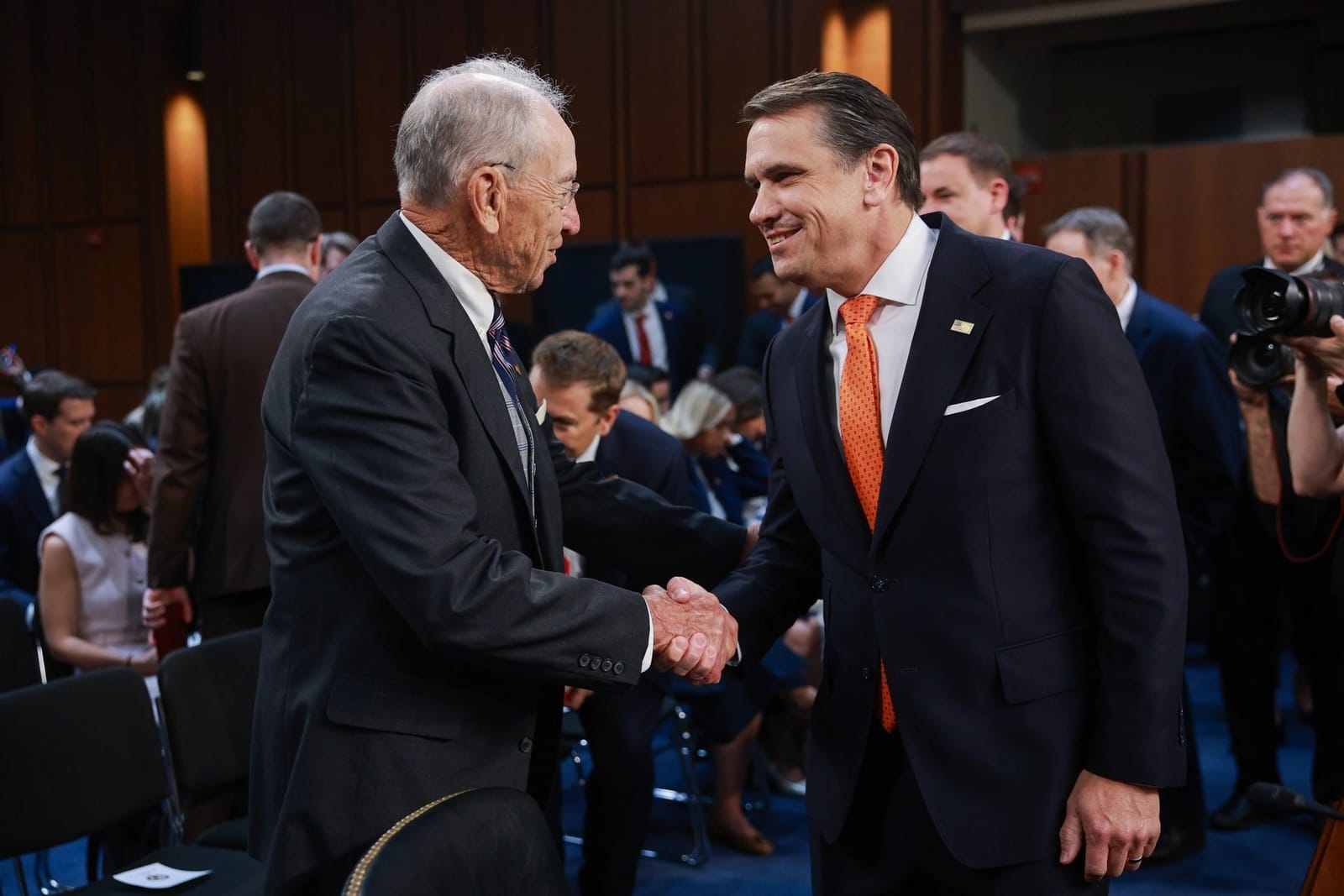
The Senate confirmed Todd Blanche1 as attorney general early Saturday morning, 50-49. Every Democrat voted no, joined by Republicans Susan Collins of Maine and Lisa Murkowski of Alaska. Bill Cassidy of Louisiana, who said as recently as Wednesday that he was undecided, cast the deciding vote. Cassidy, who lost his own primary two months ago, told the floor the choice was not between perfection and Mr. Blanche but between Mr. Blanche and some other acting attorney general who might run the department worse. Mitch McConnell was absent. Blanche has been acting attorney general since Trump fired Pam Bondi in April, and he left a law partnership to represent Trump personally in 2023. PBS NewsHour2 tracked the count into the vote; the Guardian live blog3 carried his response.
The fight that nearly sank him was about money and immunity. The Justice Department had moved to create a $1.8 billion anti-weaponization fund, built out of a settlement over the president's leaked tax returns and meant to compensate people who say the government was weaponized against them, alongside a tax arrangement covering the president, his sons and his business. John Cornyn of Texas and Thom Tillis of North Carolina demanded the cancellation in writing. Blanche provided it on August 2, stating that the establishing order is rescinded and shall have no force or effect.
Whether that settles anything is contested. Legal analysts quoted by The Guardian call the assurances far from ironclad and note they do not touch the immunity from tax audits. Murkowski made the mechanism explicit in her own statement: the fund is off the table only because the nomination is pending and the Senate has leverage, and once the vote happens that leverage ends. She voted no. The nomination passed anyway. Both things are now true at once.
What Blanche Told Anti-Abortion Activists
A second Blanche story got far less attention. Democracy Now reports4 that on a private White House Faith Office call with the group Intercessors for America, Blanche told anti-abortion activists that the department is working hand in hand with Health and Human Services and the Food and Drug Administration to get permanent solutions, so that the Dobbs decision becomes permanent in every single state.
Amy Littlefield of The Nation, interviewed on the program, lays out two routes: the FDA's safety review of mifepristone, and the Comstock Act of 1873, a Victorian-era postal law barring lewd materials from the mail, which could function as a national ban on mailed abortion pills even in states where abortion is legal. Senator Tina Smith of Minnesota says Blanche made clear in those calls that he wants to revive Comstock. Separately, the Senate confirmed Erica Schwartz as director of the Centers for Disease Control and Prevention, 51-44; Schwartz has said abortion surveillance is a critical component of what the agency is currently doing.
Littlefield's framing is argument. Blanche's own words on the call, and Schwartz's on surveillance, are the record.
The Rest of the Senate's Last Night
Republicans dropped the proof-of-citizenship voting requirement from the funding bill and passed a short-term measure pushing the next shutdown deadline past the November midterms. Trump had demanded senators stay in Washington until they passed the SAVE America Act. They went home instead, with Majority Leader John Thune and Senate conservatives agreeing to try again in September inside a broader budget package that would fund the Iran war and replenish the Pentagon.
The chamber also passed the toughest Russia sanctions bill yet, formally the Lindsey O. Graham Sanctioning Russia Act of 20265, named for the late senator who spent years pushing it. It would let the president impose tariffs of up to 100 percent on the five largest buyers of Russian oil and gas, a group that includes China and India, add sanctions on Vladimir Putin and his circle, and extend sanctions on Iran. Volodymyr Zelenskyy, who watched procedural votes from the Senate gallery late last month, called it real American pressure. Alongside it the Senate confirmed 74 nominees6, including Cameron Hamilton to run the Federal Emergency Management Agency after he was fired from that same job for publicly opposing the agency's elimination. The Senate returns September 14.
A Visa Rule Against the "Far Left" With Nothing Defined
The Intercept reports7 that Secretary of State Marco Rubio announced a visa policy in mid-July directing consular officers to deny visas to foreigners accused of supporting far-left terrorism, violent crime, economic sabotage, or logistical support to groups the department deems far-left terrorist organizations. More than three weeks on, the department has not defined far left, has not named a single designated group, and has announced no denials.
Peter Margulies, a law professor at Roger Williams University, calls economic sabotage a term broad enough to get a tank through. Carrie DeCell of the Knight First Amendment Institute says the vagueness is the point and the chilling effect is the product. A recent State Department report on Cuban influence named the streamer Hasan Piker, Amazon Labor Union founder Christian Smalls, the National Lawyers Guild and the Democratic Socialists of America. Whether any of that becomes enforcement is unknown. The authority claimed is documented.
ICE Writes Its Own Disclosure Rule
The Intercept also reports on the Combating Organized Retail Crime Act8, a bill from Senator Chuck Grassley of Iowa that would build an organized retail and supply chain crime coordination center inside Immigration and Customs Enforcement, run by a director the ICE head picks, pulling in the FBI, the Drug Enforcement Administration, Customs and Border Protection and the Secret Service, and able to receive information designated confidential under federal law, including personal financial data. It passed the House in May, and Senate leaders want it attached to next year's defense authorization bill. Thirteen Senate Democrats have co-sponsored it, including Amy Klobuchar, Mark Warner and Whip Dick Durbin. The American Civil Liberties Union warns that retailers hand over continuous surveillance footage rather than clips, including parking lot license plate reader data, and calls the result a new fusion center. The National Retail Federation, whose statistics the bill leans on, retracted its 2023 claim that organized retail crime drove half of roughly $100 billion in annual missing merchandise and later put the real share nearer 5 percent.
The Associated Press, carried by PBS NewsHour9, reports the piece that completes the set. ICE is equipping officers with body cameras by the end of September, and its own policy says video is released within 72 hours only after the agency determines release is in the best interests of the agency. The director can withhold or delay indefinitely on finding specific and compelling circumstances, a phrase the policy never defines. Every officer's face, name and badge number is redacted before anything goes out. ICE spent $30.9 million in July on Axon equipment after Congress allocated $20 million in the April 30 shutdown bill. Katherine Hawkins of the Project On Government Oversight: without a clear way for the public to get access, it does not do much good.
Trump also signed executive orders this week narrowing birthright citizenship for children of diplomatic and international organization staff, people designated alien enemies, and participants in what the administration calls birth tourism, as Drop Site News summarized10. That follows a June Supreme Court ruling striking down his January 2025 order, in which Chief Justice Roberts wrote that the Fourteenth Amendment's citizenship clause has an expansive sweep.
Colombia Swings Right, and Washington Sends $1 Billion
Abelardo de la Espriella was inaugurated president of Colombia on Friday. He moved the ceremony out of Bogota to Cali, saying he wanted it away from Congress and the seat of power. Police seized a bus loaded with explosives in southern Colombia that they believe was headed for the site. Hundreds protested.
He won the June 21 runoff with 49.7 percent against Ivan Cepeda's 48.7, a margin of roughly 250,000 votes out of nearly 26 million cast, on 63.6 percent turnout. Cepeda conceded days later. Outgoing president Gustavo Petro alleged widespread fraud, produced no evidence, and called the new government an illegitimate presidency. That allegation gets the same treatment here that an unevidenced fraud claim from any government would get: it is Petro's assertion, and it is unsupported.
What follows the ceremony is more concrete. The State Department says it plans $1 billion in security assistance to the new government. The American delegation included then acting attorney general Todd Blanche, who spoke of a great rekindling of a great partnership. Trump endorsed de la Espriella in June. On his first day the new president signaled an energy reversal, backing oil and gas exploration against his predecessor's fossil fuel policy. Andres Martinez Fernandez of the Heritage Foundation told PBS NewsHour11 he expects very little daylight between Washington and Bogota, and counted half a dozen pro-American conservative leaders taking office across the region in the past year. Gimena Sanchez of the Washington Office on Latin America gave the other half, warning that de la Espriella's promised mano dura has a record: a sharp rise in extrajudicial killings by the armed forces during Colombia's last hard-line period, falling hardest on rural, Indigenous and Afro-Colombian communities. She attached no numbers in the segment, and none are supplied here.
The structural read is simple. A government elected by one point now has a billion dollars of American security money and an explicit mandate from Washington to be hard on narcotrafficking.
The Hormuz Deal That Nearly Happened
PBS NewsHour's Nick Schifrin12, citing four regional officials and one senior American official, reports that by midweek Iran and Oman had agreed on a temporary arrangement for the Strait of Hormuz: inbound ships in a lane closer to Iran, outbound ships closer to Oman, no tolls, the strait demined, and a 60-day clock restarted that would return Washington and Tehran to a ceasefire and to talks on the nuclear program and frozen assets. Gulf states backed it despite the risk to their own imports, because they feared what Iran would do to them if the United States escalated.
Then it collapsed, and the attribution is contested. The senior American official and three Arab officials say Iranian negotiators agreed and were overridden by the Islamic Revolutionary Guard Corps, which demanded the blockade lifted, sanctions lifted, oil sales in dollars, and tolls added. Iran blames Washington for what it called theater diplomacy on loop. Ali Vaez of the International Crisis Group rejects the premise that this is a split between pragmatists and hardliners, saying the Guard is in charge and always was. Behnam Ben Taleblu of the Foundation for Defense of Democracies says the government moved the goalposts because it now believes escalation rather than engagement keeps it alive. The two analysts agree on one point only: Iran is playing for time and thinks time favors it.
Separately, Saudi Arabia, Turkey and Pakistan signed the Mecca Joint Defense Agreement, a mutual defense pledge modeled on NATO's Article 5. Three Sunni powers that have competed more than they have cooperated just built a security arrangement that does not run through Washington.
In Gaza, a Doctor Held 18 Months and a Child Killed Every Day
The United Nations Children's Fund reports that at least 300 children have been killed in the 300 days since the October 10, 2025 ceasefire. Regional director Edouard Beigbeder called it a ceasefire that leaves an average of one child dead each and every day. That is the agency's tally, published by the United Nations this week.
Drop Site News reports13 on Dr. Hussam Abu Safiya, the former director of Kamal Adwan Hospital in northern Gaza, held by Israel without charge for more than 18 months. The Palestinian Prisoners Media Office says he suffered fractured ribs and severe beatings on July 27 at the Rakevet facility inside Israel's Ramla prison complex. His family petitioned Israel's Supreme Court in April; the court rejected the appeal on June 16, citing confidential material never shown to the defense. His lawyer found him in critical condition on July 2. His son said the account read like a farewell message from a human being who feels his life is nearing its end.
Drop Site also gives a tally of roughly 1,700 healthcare workers killed since October 2023, more than 370 arrested and 82 still held. The piece does not name the body that produced those numbers, so they stand as Drop Site's reporting rather than as an established count. No Israeli government response appears in the article.
The Jobs Report Is Worse Than the Rate
The July report is worse than the headline suggests. The Bureau of Labor Statistics reported a loss of 23,000 jobs against expectations of modest growth, and revised May and June down by a combined 103,000. The unemployment rate fell from 4.2 to 4.1 percent, and it fell for the wrong reason: people left the search rather than found work. Labor force participation hit a five-year low, with declines concentrated among workers 55 and older, young workers and the foreign born. Wage growth came in at 3.2 percent, the weakest in five years and effectively erased by inflation. Hospitality, education, retail and financial services all shed jobs. Two sectors grew: health care, on an aging population, and construction, on data center building for artificial intelligence. More than 845,000 women have left the workforce this year against about 400,000 men, concentrated among mothers of young children priced out by childcare, per PBS NewsHour's analysis14. That is not a soft landing. That is a labor market shrinking quietly enough to keep the rate flattering.
Against that, the White House is trying again to remove Federal Reserve governor Lisa Cook. She received a letter this week saying the president is considering her removal15 over the same unproven mortgage fraud allegations he made a year ago, giving her 21 days to respond. The Supreme Court ruled 5-4 in June that she could stay while she litigates, holding that Trump failed to afford her the procedural protections she was owed by statute. Her lawyer Abbe Lowell calls the new letter a pretext. Cook was appointed by Joe Biden in 2022 to a term running to 2038 and is the first Black woman to serve as a Fed governor. The sequence is the story rather than the merits: lose at the Supreme Court, then re-run the same removal through the procedure the Court described.
A second removal-power question landed the same week. A 2-1 D.C. Circuit panel ruled that the president needs congressional approval16 to build the White House ballroom, with a 14-day window for appeal.
Puerto Rico Is Rationing Water
Rationing began this week. Water shuts off across the island in rotating 48-hour blocks, and Governor Jenniffer Gonzalez Colon has been on television telling people to turn the tap off while they lather. Laura Perez Sanchez, an independent investigative reporter in San Juan, told PBS NewsHour17 that the schedule is not tracking reality: people slated to lose water still have it, and communities in San Juan and elsewhere have gone more than a year without it already with no explanation.
The drought is real and has run since roughly May. But experts she has spoken to estimate the system loses close to 60 percent of its water before it reaches a customer, and at the reservoir where rationing is being implemented, 90 million gallons a day come out and 65 million reach the system. That is a reported estimate, not an official utility figure. The drought is the trigger. Deferred maintenance is the cause.
The Buildout, from the Ground
404 Media obtained a presentation18, released through a public records request by a Georgia resident named Jason Hunyar, showing that the license plate reader company Flock drew up a plan to pull plate data from roughly 350,000 Uber, Lyft and delivery driver dashcams through a partnership with the camera maker Nexar. Flock's cameras normally sit on poles. This would have put the network in motion, riding along in commercial vehicles. Flock told 404 Media it never executed the partnership. It is not clear whether Uber, Lyft or any driver would have known. For context, hackers previously accessed terabytes of Nexar video including footage near Defense Department sites, and Flock abandoned a people-lookup tool built on hacked data after coverage and internal objections.
In Emporia, Kansas, the city commission moved its meetings online19 with no public comment period, citing public safety, after a teacher named Lux Claridge was arrested and charged with disorderly conduct for clapping at a July 22 meeting about the Flint Hills Digital Campus, a proposed gigawatt-scale data center on a thousand acres of prairie. The police chief told a local station that city leaders had received death threats, and Mayor Becky Smith indicated they appeared to come from outside the community. Claridge's question is the right one: if the threats were not local, why was local public comment the thing that got removed. At the first virtual meeting the commission voted 5-0 to ask a judge whether Kansas law would let it ban high-impact data centers.
Two more from the same current. The Intercept reports20 the State Department has brought Palantir into a new Freedom Tech Excellence Program, placing company employees inside the department to advise on digital freedom, freedom of expression, privacy-enhancing technologies and countering digital surveillance, running through early 2029. Anduril is also a partner. Palantir has a 15-year relationship with Immigration and Customs Enforcement, built the analytical tools used in raids, and appears in the Snowden documents as a contributor to National Security Agency global collection. Carrie DeCell called the announcement doublespeak. And Reuters reports that Nvidia plans to invest up to $3 billion in Lancium, a developer building data centers for the Stargate project; that figure is Reuters relaying The Information, not a closed deal.
Hold the three together: the plate readers, the town that stopped taking public comment about a gigawatt campus, and the surveillance contractor hired to advise on countering surveillance.
The Electoral Left, and the Money Against It
Abdul El-Sayed won Michigan's Democratic Senate primary on August 4, defeating Congresswoman Haley Stevens, and would be the first Muslim United States senator if he wins in November. On Democracy Now21 he put the outside money against him at roughly $70 million, an 11-to-1 disadvantage, with more than $30 million from the American Israel Public Affairs Committee. Those are his figures from an interview rather than verified filings, and they are carried as his claim. What is not in dispute is the mechanic he ran on: that a government sending tax dollars abroad for weapons while people cannot cover groceries or rent is a losing proposition with voters, and that a field program knocking 200,000 doors in the final two weeks can beat the money.
The same money is now in Minnesota, where the primary to succeed Angie Craig is Tuesday, August 11. Drop Site News, working from filings22, reports more than $3 million from pro-Israel aligned committees in a three-way race among Matt Klein, Matt Little and Kaela Berg. AIPAC's super political action committee moved $850,000 to the EDW Action Fund in May, and EDW and a sister group spent about $395,000 backing Berg. Democratic Majority for Israel moved $500,000 to Women Vote, the independent expenditure arm of EMILY's List, which then spent $584,448 for Berg. The largest single spender is 314 Action Fund, at nearly $2.5 million for Klein by late July plus another $1.2 million on August 5, after Michael Bloomberg gave the group $2.5 million in May. The candidates differ on Gaza: Klein declines to call it a genocide, Little calls for recognizing genocide and suspending military aid, and Berg has called for ending all weapons sales to Israel.
In Kansas, Democratic gubernatorial nominee Cindy Holscher told Democracy Now23 she wants a statewide moratorium on new hyperscale data centers, and said she had voted for a data center incentive program before and would not dig in on a bad vote. She faces Trump-endorsed state Senate president Ty Masterson in November.
Also This Week
Veterans' mental health staffing. More than 60 House Democrats, led by Representative Judy Chu of California, a psychologist, wrote to Veterans Affairs Secretary Doug Collins24 demanding the department disclose the scale of its mental health staffing shortage. The letter follows ProPublica's finding that the department had about 500 fewer psychologists and psychiatrists in January than a year earlier, that one Arizona psychologist described one-on-one sessions replaced by group sessions holding as many as 35 veterans, and that the individual appointments that remain run about 16 minutes. Russell Lemle, a former chief psychologist at the department: when you lose them, the veterans are the ones who pay the price. The department says it completed a record number of mental health appointments while cutting wait times, a claim that is the department's own and is not independently verified. Lawmakers want an answer by August 14.
Foreign aid routed to ideology. ProPublica followed25 congressionally appropriated foreign aid into the State Department's Bureau of Democracy, Human Rights and Labor, where proposals include roughly $1 million for research into crime against Afrikaners in South Africa. The intended recipient is a group called Lex Libertas, founded by Ernst Roets, an advocate of Afrikaner self-governance, which plans to place 3,000 white crosses on the National Mall. Another proposal would send about $5 million to a British free speech organization opposed to bans on conversion therapy. Trump has repeatedly claimed a genocide of white South Africans; research cited by ProPublica finds white South African farmers are not victimized by crime at higher rates than anyone else. The State Department says the programs remain in deliberation. Mattie Webb of the Virginia Military Institute says the shift moves aid away from programs serving far more South Africans toward a narrow focus on the white minority.
American money in British politics. The Guardian reports26 that the United States embassy in London has published grants of up to $500,000 under a program called Liberty Under Law, the Shared Anglo-American Tradition, inviting charities and nonprofits to run high-visibility public education programs on freedom of speech and limited government. These appear separate from $12 million the State Department plans to allocate to British organizations founded by Jacob Rees-Mogg and Toby Young, revealed in leaked documents the paper obtained earlier. A current or recently departed State Department official told the paper that funding topics tied to a narrow America First vision is highly unusual, and accused the government of trying to create British-originated narratives to support movement propaganda. The embassy replied that it had discontinued Biden-era spending on divisive ideological projects. A second embassy scheme invites applications for programs securing British support for American policy, including ensuring support for Israel's right to defend itself. A former official's reaction: increasing support for Israel in a third country is weird.
What to Watch Next
The Blanche Justice Department now has no confirmation leverage hanging over it, so the near-term test is whether the $1.8 billion fund and the tax immunity arrangement stay dead, and whether the FDA mifepristone review or a Comstock Act theory surfaces as formal action. The White House has two weeks to take the ballroom ruling to the Supreme Court, and Lisa Cook has 21 days to answer a removal letter, so both land inside the month. Tuesday's Minnesota primary is the cleanest test yet of whether the Michigan result was a Michigan story or a pattern. Whether Colombia's billion dollars comes with conditions, and what de la Espriella does in his first weeks on fossil fuel licensing and on security operations in rural departments. The Strait of Hormuz, where the failed deal leaves shipping at a trickle and both sides convinced time is on their side. And the September 14 return, when the SAVE America Act, a budget package meant to fund the Iran war, and the hemp fight all come back at once.
The Coverage Gap
The diff between conservative outlets and left and independent outlets cuts both ways today, and the more useful half is the second one.
Start with what conservative outlets carried and left and independent outlets did not. Two accountability stories reached this briefing only through right-of-center newsletters. The Senate Homeland Security Committee voted this week to hold Anthony Fauci in contempt of Congress after he invoked the Fifth Amendment, referring the matter to the Justice Department and attempting to bypass a floor vote. Left and independent outlets covered the culture war around Fauci, with The Atlantic asking why the movement hates him and Slate examining Rand Paul's motives, but not the procedural event itself. Second, the Government Accountability Office found that the Department of Government Efficiency overstated its savings, reporting that the roughly $110 billion claimed on its wall of receipts rests on incorrect estimates, unverifiable calculations and undocumented methodology. That is a finding the left is structurally positioned to want, it broke Friday, and it arrived here via The Dispatch27 rather than through the reporting spine.
Third, National Review ran two separate pieces on a munitions and defense industrial base shortage. Whatever the politics, production capacity is a material question, and the left and independent sample carried nothing on it. Fourth, National Review engaged the constitutional substance of the removal power case behind the Lisa Cook fight, and argued that the new birthright citizenship orders narrow rather than widen the legal dispute. Left and independent outlets covered both outcomes without engaging the strongest legal argument on the other side. Fifth and smallest, the Washington Examiner reported a pay-to-play allegation over Airbnb's $750,000 to Los Angeles Mayor Karen Bass amid a rental policy fight, and Breitbart flagged an Associated Press and NORC poll showing stronger public support for deportations. Both are checkable claims, and neither appeared on the other side.
Much of the conservative volume was amplification rather than reporting, which is framing intelligence rather than a failure by anyone. The dominant story on that side was socialism panic: Fox News ran at least four separate socialism items, National Review two more including a piece asking whether socialism is really coming, and The Daily Wire compared Democratic Socialists of America candidates to a Batman villain. That is a coordinated framing response to the Michigan and Kansas primary results, not a news event, and left and independent outlets engaged it at the level of the frame rather than the substance, with Vox calling it an imaginary Red Scare and Jacobin arguing about centrist Democrats. Also running hot on that side: a transgender athlete controversy in the Women's National Basketball Association, immigration crime anecdotes tied to people released under the previous administration, and a Temporary Protected Status termination for Burma framed as a win.
Now the other direction, which is the more uncomfortable half. Puerto Rico's water rationing, an American infrastructure failure affecting American citizens, drew nothing from any of the seven conservative feeds. Neither did ProPublica's veterans mental health staffing story, on a constituency the conservative press claims to own. Neither did the ICE body camera disclosure policy, where a federal agency wrote itself a rule letting its own director suppress any video indefinitely. Neither did Drop Site's filings work on pro-Israel money in the Minnesota primary, or its reporting that the Knight Foundation granted money to the pro-Israel pressure group Honest Reporting. Neither did the UNICEF tally of children killed during the ceasefire, or the Guardian's reporting that the American embassy in London is funding public education programs inside British politics.
And most tellingly, 404 Media's Flock and Nexar story, a plan to turn a third of a million private vehicles into a roaming license plate surveillance network, drew nothing from a press that describes itself as skeptical of the surveillance state. That absence does not split along the usual axis, which is what makes it the most interesting silence on the board.
One structural note that applies to the press generally. Four outlets running four socialism items in a day is one story, not four, and counting it as coverage is how volume gets mistaken for reporting. The same day, the two documented stories about who can be watched and who can see the footage, the ICE body camera rule and the Flock pitch, appeared in one outlet each.
Method
This edition was assembled from an unattended cloud run on August 8, 2026. Feeds were staged deterministically from RSS: 23 of 24 resolved, with National Public Radio failing on malformed XML, a feed URL that needs re-pointing. Article bodies for the reporting spine were read in full by six parallel reader agents. Wire items from Reuters and the Associated Press, and paywalled items from The Atlantic, Wired and The Dispatch, are headline and summary only by design and were treated as such.
Sources are weighted toward original reporting over aggregation, and toward outlets that read the filing or the policy document over outlets that read the press release. Opinion and analysis are labeled as argument wherever they appear, never carried as reported fact.
Every figure, date, toll, vote count and officeholder in the body was checked against live web search: 20 searches and fetches covering the Blanche tally, the July jobs report, the Graham sanctions bill, the Colombian runoff and inauguration, the $1 billion Colombia package, the birthright citizenship orders, the ballroom ruling, the Puerto Rico rationing, the Fauci contempt vote and the GAO finding on DOGE savings. Neither The Guardian nor PBS carried the 50-49 tally, which was added from live search against NPR and CNBC.
Corrections this edition: seven mechanical, seven judgment calls. The largest were a wrong primary date in a Drop Site piece, printed as August 8, a Saturday, and corrected to Tuesday, August 11 against Ballotpedia and the Star Tribune; an unattributed Gaza healthcare-worker tally kept as the outlet's reporting rather than as fact; and a candidate's own campaign-spending figures carried as his claim rather than as verified filings. Drop Site's causal claim linking Honest Reporting's output to the killing of a photographer is the outlet's allegation and was left out of the body.
Government casualty, damage and fraud claims are attributed to the government that made them, one standard regardless of which government, including Gustavo Petro's unevidenced fraud allegation in Colombia and the unproven mortgage fraud allegations against Lisa Cook. No figure was invented to patch an unverifiable claim.
Footnotes
27 footnotes, 27 unclassified.
A footnote carrying a classification was authored as a source record. The rest are the edition's own citations as published: outlet and address as they stood, with no classification, attribution posture or reading depth on record.
- 1
The Guardian (opens in a new tab)theguardian.com
confirmed Todd Blanche
- 2
PBS NewsHour (opens in a new tab)pbs.org
PBS NewsHour tracked the count into the vote; the Guardian live blog carried his response.
- 3
The Guardian (opens in a new tab)theguardian.com
PBS NewsHour tracked the count into the vote; the Guardian live blog carried his response.
- 4
Democracy Now! (opens in a new tab)democracynow.org
Democracy Now reports that on a private White House Faith Office call with the group Intercessors for America, Blanche told anti-abortion activists that the department is working…
- 5
The Guardian (opens in a new tab)theguardian.com
Lindsey O. Graham Sanctioning Russia Act of 2026
- 6
PBS NewsHour (opens in a new tab)pbs.org
confirmed 74 nominees
- 7
The Intercept (opens in a new tab)theintercept.com
The Intercept reports that Secretary of State Marco Rubio announced a visa policy in mid-July directing consular officers to deny visas to foreigners accused of supporting…
- 8
The Intercept (opens in a new tab)theintercept.com
Combating Organized Retail Crime Act
- 9
PBS NewsHour (opens in a new tab)pbs.org
The Associated Press, carried by PBS NewsHour, reports the piece that completes the set.
- 10
Drop Site News (opens in a new tab)dropsitenews.com
Trump also signed executive orders this week narrowing birthright citizenship for children of diplomatic and international organization staff, people designated alien enemies, and…
- 11
PBS NewsHour (opens in a new tab)pbs.org
Andres Martinez Fernandez of the Heritage Foundation told PBS NewsHour he expects very little daylight between Washington and Bogota, and counted half a dozen pro-American…
- 12
PBS NewsHour (opens in a new tab)pbs.org
PBS NewsHour's Nick Schifrin
- 13
Drop Site News (opens in a new tab)dropsitenews.com
Drop Site News reports on Dr. Hussam Abu Safiya, the former director of Kamal Adwan Hospital in northern Gaza, held by Israel without charge for more than 18 months.
- 14
PBS NewsHour (opens in a new tab)pbs.org
More than 845,000 women have left the workforce this year against about 400,000 men, concentrated among mothers of young children priced out by childcare, per PBS NewsHour's…
- 15
The Guardian (opens in a new tab)theguardian.com
considering her removal
- 16
PBS NewsHour (opens in a new tab)pbs.org
ruled that the president needs congressional approval
- 17
PBS NewsHour (opens in a new tab)pbs.org
Laura Perez Sanchez, an independent investigative reporter in San Juan, told PBS NewsHour that the schedule is not tracking reality: people slated to lose water still have it, and…
- 18
404 Media (opens in a new tab)404media.co
404 Media obtained a presentation, released through a public records request by a Georgia resident named Jason Hunyar, showing that the license plate reader company Flock drew up…
- 19
404 Media (opens in a new tab)404media.co
moved its meetings online
- 20
The Intercept (opens in a new tab)theintercept.com
The Intercept reports the State Department has brought Palantir into a new Freedom Tech Excellence Program, placing company employees inside the department to advise on digital…
- 21
Democracy Now! (opens in a new tab)democracynow.org
On Democracy Now he put the outside money against him at roughly $70 million, an 11-to-1 disadvantage, with more than $30 million from the American Israel Public Affairs Committee.
- 22
Drop Site News (opens in a new tab)dropsitenews.com
Drop Site News, working from filings, reports more than $3 million from pro-Israel aligned committees in a three-way race among Matt Klein, Matt Little and Kaela Berg.
- 23
Democracy Now! (opens in a new tab)democracynow.org
In Kansas, Democratic gubernatorial nominee Cindy Holscher told Democracy Now she wants a statewide moratorium on new hyperscale data centers, and said she had voted for a data…
- 24
ProPublica (opens in a new tab)propublica.org
wrote to Veterans Affairs Secretary Doug Collins
- 25
ProPublica (opens in a new tab)propublica.org
ProPublica followed congressionally appropriated foreign aid into the State Department's Bureau of Democracy, Human Rights and Labor, where proposals include roughly $1 million…
- 26
The Guardian (opens in a new tab)theguardian.com
The Guardian reports that the United States embassy in London has published grants of up to $500,000 under a program called Liberty Under Law, the Shared Anglo-American Tradition,…
- 27
The Dispatch (opens in a new tab)thedispatch.com
That is a finding the left is structurally positioned to want, it broke Friday, and it arrived here via The Dispatch rather than through the reporting spine.