Issue 39 of The Open Record
The War Is Now a Price, and the Election Is Now a Docket
Brent crude closing on $100 a barrel, the most expensive Labor Day gasoline on record, and a federal judge blocking the Postal Service from rewriting mail-voting rules with fewer than 70 days until November.
Daily news review for Tuesday, September 8, 2026. Every source is footnoted. A note on method is at the bottom.

0% read, about 20 min remaining
The war with Iran has stopped being a foreign policy story and become a price. That is the thread running through almost everything today.
Oil is closing on $100 a barrel. American drivers just paid the most expensive Labor Day gasoline on record. A new front opened overnight when Houthi forces hit Saudi energy facilities1.
Underneath that runs a second thread: the machinery of the November election is being fought over in federal court while the campaign itself absorbs another act of political violence. Money and votes, both under pressure, both from the same direction.
The War Arrives at the Pump
Early Tuesday, attacks struck civilian and economic sites in the Saudi cities of Abha, Jazan, Najran and Khamis Mushait, setting fires at oil facilities and utilities across the kingdom's southern region. The Saudi Energy Ministry confirmed the fires and a temporary suspension of operations. Seventy-three people were wounded, including women and children, according to Major General Turki al-Malki of the Saudi-led coalition, who called it a serious escalation and called for retaliation. That casualty figure is the coalition's own, not an independent count, and the Houthis had not claimed the strikes at the time of these reports. CNN reported them2 as a major regional escalation. They follow weeks of fighting that broke a four-year truce in Yemen's civil war, and mark the second hit on Aramco's Jazan refinery in about a month.
The market moved before the smoke cleared. Brent traded around $97 a barrel on Monday, up about 9% in five days and 19% in a month, and opened Tuesday climbing toward $1003 as analysts told Al Jazeera4 the supply deficits are persisting with little end to the shortages.
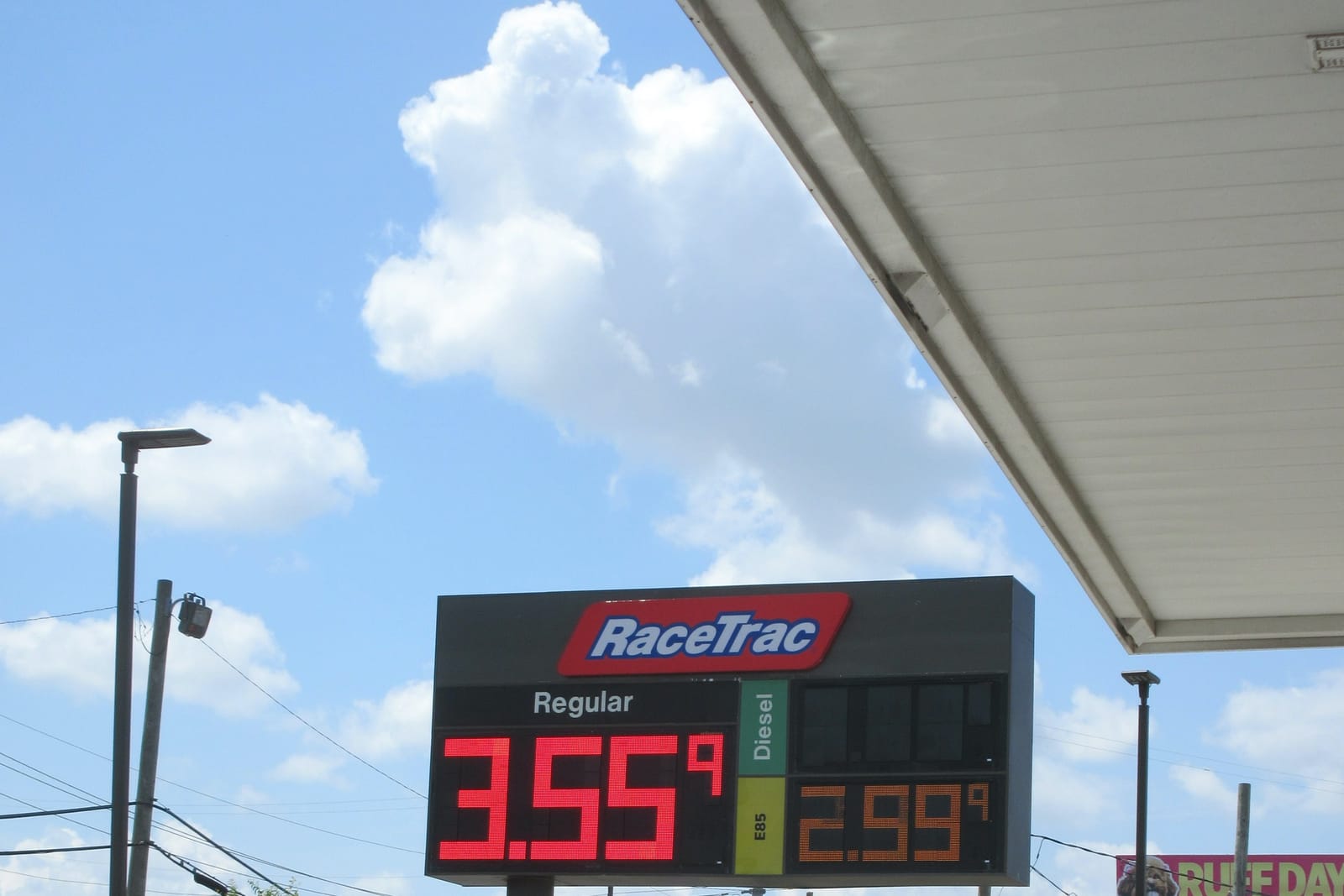
Americans are already paying for it. The American Automobile Association put regular gasoline just above $4.14 a gallon heading into Labor Day, the most expensive Labor Day on record5 and nearly a dollar higher than a year ago. Diesel set an outright all-time record of $5.85 on Friday6, which matters more than the headline number, because diesel is what moves freight and food. The causes stack: Hormuz crude traffic collapsed after the American and Israeli attacks on Iran in February, American refineries are running at 98% of capacity in brutal Texas heat, Ukrainian drone strikes have squeezed Russian refinery output, and Chinese refiners are producing less.
On the strait itself the two governments tell incompatible stories, and both are claims rather than findings. Energy Secretary Chris Wright said Sunday that 9 million barrels a day are still getting through; a senior American official said Monday the strait is fully open and under United States Navy control7. Mohsen Rezaei, who heads Iran's Supreme National Security Council, announced plans for an exclusion zone8 running from the American blockade line toward the strait, with any ship transiting it placed on an Iranian sanctions list. What is documented rather than claimed is the blockade: more than 20 warships, 92 commercial ships redirected, 3 disabled. Wright was blunt about the aim. We are strangling their economy, he said, to try to bring either a change in policy from the existing regime or a new regime.
There is a human floor under the price chart. In Minab, in southern Iran, the Shajareh Tayyebeh school was struck on February 28 in the war's opening hours and is now a memorial9. Iranian officials say more than 100 students were killed there, which is the Iranian government's figure. What is not the Iranian government's figure is this: an Associated Press investigation found evidence that at least one American missile hit the school. The administration has not accepted responsibility and has not released the Pentagon's findings. A new round of American strikes along Iran's southern coast last week hit a wedding.
In Southern Lebanon, the Ceasefire Is a Map
Two Israeli airstrikes hit the village of Kfar Rumman on Monday, killing at least 12 people10 according to Lebanon's Health Ministry: 11 in a building, including two children and four women, and a paramedic in a car. The Israeli military said the strikes answered two Hezbollah drone attacks and targeted a militant moving weapons into the village; that is the military's account. The mayor, Abdullah Farhat, called it a massacre11 in every sense of the word. A United States-brokered ceasefire signed in June has been violated repeatedly since.
PBS NewsHour did the harder work of showing what the occupation looks like when nothing is exploding. Correspondent Simona Foltyn reported from three villages12 and found a sectarian map drawn in rubble: dozens of Shia villages razed by the Israeli Army while Christian and Sunni villages stand largely intact or under Israeli control. The most damning line is not from a critic. It is from Israeli Defense Minister Israel Katz, on the record: 24 Lebanese villages hundreds of years old, Shiite residents, we destroyed all of the buildings, not one house. The military told PBS it operates in accordance with international law and categorically rejects claims of collective punishment and ethnic cleansing. A recent United Nations report urged officials to stop rhetoric that dehumanizes the Lebanese population and legitimizes collective punishment on grounds of ethnic origin. Two things in the segment are true at once: the family who lost three relatives to a June strike agree Hezbollah must disarm, and want civilians allowed home.
Britain acted on the adjacent file today. Foreign Secretary Ed Miliband is announcing a ban on importing goods produced in Israeli settlements13 in the occupied West Bank, following coordinated sanctions in June over settler violence, with Reuters carrying the same announcement. That is a real policy break by a Group of Seven government, and it sets up a direct clash with Washington. It is also the government of Prime Minister Andy Burnham, who replaced Keir Starmer in July.
The Election Fight Has Moved into the Courtroom
At the center is Trump's executive order restricting mail voting and directing the Postal Service to write rules implementing it. Federal judge Indira Talwani in Massachusetts has blocked the Postal Service rule twice. The most recent order came on a Friday night, and the two available accounts do not match: the Guardian reports14 that Talwani made her injunction permanent on September 4, while SCOTUSblog describes15 a preliminary injunction replacing an August 27 restraining order. The narrower characterization is the safer one. Either way, the finding was that a final rule taking effect fewer than 70 days before the election threatens disenfranchisement of millions, and that the record contains no evidence of fraudulent mail voting to support the rush. Solicitor General John Sauer has gone to the Supreme Court repeatedly to get the block lifted, and the Court already lifted one earlier injunction16 in this litigation on August 24.
The pressure is not confined to that case. In July, Harmeet Dhillon, who runs the Justice Department's civil rights division, warned officials in all 50 states that any election officer knowingly keeping noncitizens on a voter list could face criminal liability, and in August the department announced plans to send 1,000 lawyers to monitor voting nationwide. Hundreds of Homeland Security agents have been working to find noncitizens among registered voters, per documents reviewed by the New York Times, and the department's chief has said immigration agents could be sent to polling places. Sophia Lin Lakin of the American Civil Liberties Union says the administration has lost 23 of the cases decided so far over seizing voter data from states. The underlying claim that mail ballots are inherently corrupt is unsupported: the Heritage Foundation's own database counts roughly 100 noncitizen voting cases across a quarter century, and Trump voted by mail twice this year.
The detail that should travel furthest is not a partisan complaint. Republican governors are objecting. Wyoming's Mark Gordon called federal agents monitoring poll workers17 a bit aggressive and irregular, and said he does not like the federal government coming in and taking our votes any more than taking our guns. Oklahoma's Kevin Stitt, who supports a proof-of-citizenship bill, told the Associated Press he does not think elections should be federalized at all.
The campaign itself took another hit Sunday. The Ohio State Highway Patrol says an armed man charged toward Amy Acton18, the Democratic candidate for Ohio governor, at the Canfield Fair, forcing through a crowd and knocking over audience members before troopers stopped him. Several people were injured. The patrol identified the man as Patrick Havas, 38, and said he carried a taser and two pistols; the Mahoning County Sheriff's Office said no weapon was ever drawn. Republican Governor Mike DeWine, Republican Senator Jon Husted and the campaign of Acton's Republican opponent Vivek Ramaswamy all condemned it quickly and without hedging, which is worth crediting.
A Good Jobs Report Became a Political Problem
August payrolls came in at 162,000, beating forecasts19, with unemployment at 4.1%. Trump responded from the Oval Office with a list of grievances about inflation, interest rates and the Federal Reserve, and insisted that success does not cause inflation, stupidity causes inflation.
The numbers underneath explain his frustration better than his framing does. Growth has run around 2% a year, slower than under Biden. Federal debt has crossed $40 trillion, the annual deficit runs near $2 trillion and is projected past $3 trillion in a decade, the 10-year Treasury yield rose Friday to 4.79%, and wage growth is still lagging inflation20. His approval on the economy sat at 32% midsummer, against 50% when Republicans last faced midterm voters under him in 2018. Ernie Tedeschi of Stripe made the sharpest point21: even sustained growth above 3% for a decade would only stabilize the debt load, and planning on the optimistic artificial intelligence scenario is not planning.
Canada's answer to the trade war landed this morning. Retaliatory tariffs on about $20 billion of American goods22 took effect at 12:01 a.m. Eastern, at rates from 15% to 50% across steel, furniture, clothing and electronics, announced in late August23 by Prime Minister Mark Carney after talks collapsed. The Associated Press notes they have already become a problem for Republicans in the Maine and Michigan Senate races, which is what happens when a trade fight meets a border constituency.
Union Membership Grew Most Where the Law Protects Bargaining
The day produced the most interesting structural story of the cycle, and it cuts against the mood. Union membership in the United States rose by 411,000 in 202524, the largest single-year increase since 2008, per a report from the Illinois Economic Policy Institute and the Project for Middle Class Renewal at the University of Illinois.
The geography is the finding. Roughly 305,000 of those members came in states that protect collective bargaining, against about 107,000 across the 26 right-to-work states. States with protections hold more than 10.9 million members among 76.9 million workers; right-to-work states hold 3.7 million among 69.7 million. The wage gap between the two groups more than doubled over a decade25, from 3.2% in 2015 to 6.7% in 2025, which the report puts at more than $4,000 a year for a median full-time worker. Public opinion is not the constraint: Gallup finds 71% approval for unions, and an AFL-CIO poll before Labor Day found 52% of the public trust unions against 32% for the Democratic Party and 26% for the Republican Party. The institution people trust is not either party.
Set against that, the Guardian's Steven Greenhouse assembled the ledger on the other side26: workplace safety inspections down 20% from Biden's last year, a proposal to strip federal minimum wage and overtime protections from 3 million homecare workers, a campaign to end collective bargaining for 1 million federal employees that AFL-CIO president Liz Shuler calls the largest single act of union busting in American history, the federal contractor minimum wage cut from $17.75 to $13.30 an hour, a rescinded overtime rule removing time-and-a-half eligibility from 4.3 million workers, and the first firing of a National Labor Relations Board member by a president.
Two items in that ledger are not policy at all. Homeland Security obtained financial records from the Service Employees International Union and the Communications Workers of America as part of what it called a domestic terrorism financing inquiry into opposition to immigration raids in Minnesota, and federal prosecutors told a grand jury that the AFL-CIO and several unions were part of a criminal conspiracy to obstruct immigration agents there. Whatever one makes of the underlying protests, treating a federation representing 15 million people as a criminal conspiracy is a different kind of act than a rule change.
Two responses arrived, both argument rather than reporting. National Review ran Labor Day pieces arguing the holiday is a triumph of capitalism and that organized labor mostly ratified living-standard gains productivity had already produced; that is a real position with real economists behind it, and the membership data is the empirical test it has to pass. From the other direction, New York Mayor Zohran Mamdani signed an executive order creating a Mayor's Office of Worker Power27 under former United Auto Workers organizing director Tony Perlstein, with a stated job of organizing rather than enforcement. The claim that it is the first such municipal agency in the country comes from the administration and from Jacobin, with no independent verification offered, and its budget, staffing and legal authority are not public.
In Saxony-Anhalt, the Firewall Is Failing
The Alternative for Germany party, the AfD, won the state election28 on Sunday with 44.1% of the vote and 39 of 83 seats, three short of a majority. Turnout jumped to 76% from 60% in 2021. The Christian Democratic Union collapsed to 17.1%, and Chancellor Friedrich Merz called it the party's most serious defeat in decades29.
The AfD ran on a remigration and deportation offensive, banning rainbow flags in schools, halting new wind farm construction, and replacing the state slogan Think Modern with Think German. Liana Fix of the Council on Foreign Relations told PBS30 that blocking the AfD from governing would now require a coalition of all five other parties, from conservatives to the far left, and that the firewall the mainstream built is genuinely crumbling. She also flagged party proposals to teach less about the Nazi era, to push public broadcasters out of the state, and to seek closer ties with Russia and China. German domestic intelligence designated the party extremist last year.
The victory lap came from outside Germany. Elon Musk wrote Well done in German31 to co-founder Alice Weidel, lead candidate Ulrich Siegmund thanked him publicly, and Russian presidential envoy Kirill Dmitriev called it a historic win for the pragmatic AfD. Two more state elections follow in late September, including Berlin.
A Health Department Published a Report That Is Not Health Research
The Department of Health and Human Services published a report linking what it calls gender ideology to left-wing authoritarianism and a willingness to justify political violence. The document was not peer reviewed32 and not published in a journal. Its evidence base is an online survey of 1,208 people ranking statements about supporting trans people, political ideology, and political violence.
Epidemiologist Gideon Meyerowitz-Katz of the University of Sydney said the only thing reported is correlations, that the instrument is not a plausible measure of authoritarianism, and called the result pseudoscience. Daniel Aaron of the University of Utah's law school argued it likely violates the federal Information Quality Bulletin, which requires peer review for influential government science, and noted that the report is not health related, which makes its appearance under a health department hard to explain. Colin Wright of the Manhattan Institute, one of the authors, told the Guardian the report went out early because a draft leaked and will be submitted to a journal. The department did not answer questions about whether it commissioned the work.
This lands the same week the Justice Department reached an agreement with a New York hospital to stop pediatric gender-affirming care, with dozens of hospitals having already stopped under investigation and a proposed rule that would cut federal funding to any health system that offers it.
Three Data Stories That Point in Different Directions
Grindr will pay £26 million to settle a British group claim33 from 12,000 users who alleged the app shared sensitive personal information, in some cases including HIV status, with advertising companies up to early 2020, when it was owned by the Chinese firm Beijing Kunlun Tech. The settlement carries no admission of liability and works out near £2,167 a person if split evenly. It is not a first offense: Norway's data protection authority fined the company 65 million kroner in 2021, upheld on appeal last October.
Second, the Guardian reports roughly 120,000 Flock automated license plate cameras across the country running about 2 billion scans a month, with documented abuses by police including stalking former partners and tracking people seeking abortions, and heavy use by immigration enforcement.
Third, pointing the opposite way, the administration used the American embassy in London to warn that Britain's plan to give established broadcasters more algorithmic prominence risks facilitating censorship34 and could establish a template authoritarian regimes could invoke. The argument is not stupid on its face. It is also being made by a government currently deploying immigration agents around polling places, which is worth noticing about who makes a free speech argument and when.
Enforced Reverence, as Argument
The Intercept published a piece by Katherine Krueger arguing that the right's attempt to enforce reverence for Charlie Kirk after his killing last September produced the opposite of reverence35. The causal claim is hers and it is argument, not reporting. The enforcement she catalogs is documented: Pentagon investigations into service members judged insufficiently mournful, State Department visa revocations, a Tennessee man arrested over a Facebook meme and later freed, firings across schools, media and retail, a suspended late-night host. Her reporting on the movement itself stands on its own: Turning Point USA is run by his widow, there is no clear successor, and prominent figures on the right are publicly feuding while conspiracy theories about who killed him circulate among his own followers. The man charged, Tyler Robinson, has not yet been tried.
Also This Week
Miami. Federal investigators are on the ground after Amazon Air flight 7598, a 32-year-old Boeing 767 operated by the cargo carrier 21 Air, overran runway 30 on Sunday36 and traveled about 1,300 feet past the pavement, killing five people and injuring five more. National Transportation Safety Board chair Jennifer Homendy said the plane struck a van carrying seven contract cleaning workers. Investigators are examining the absence of an arresting bed at the runway end; Miami has none, while the Federal Aviation Administration says more than 120 airports do.
Iceland. The government summoned the American ambassador37 after Trump posted a map showing the island under an American flag.
Nepal. The flood death toll reached 1,34238 with 4,886 missing as of Friday, alongside 43 dead and 519 missing across the border in Tibet by Chinese government count.
Arlington. Trump officials removed a sign39 criticizing the Confederate memorial at Arlington National Cemetery, which the Washington Post reported Monday and which reads as a step toward restoring the monument itself.
Curricula. WIRED and Grist reported that plastics companies are writing lesson plans40 for public schools.
The Coverage Gap
Reading a day's news across the political spectrum produces a two-way diff, and today's runs in both directions.
Start with what conservative outlets carried and left and independent outlets did not, because the first item is the largest story in this edition that almost nobody on the left touched. On Monday, United States Southern Command sank a fifth vessel in under two weeks41 in the eastern Pacific, an alleged refueling station tied to the Ecuadorian group Los Choneros. Fox News, the New York Post and the Washington Examiner all ran it. The left and independent feeds ran nothing. The figure that makes this a real gap rather than a wire item: at least 227 people have been killed in 68 American strikes on boats in the Caribbean and Pacific since the campaign began more than a year ago, and Ecuadorian authorities said they found no evidence that one survivor had engaged in criminal activity. Critics have questioned both the legality and the effectiveness. The vessel's cartel link is Southern Command's claim. What is documented is an extrajudicial killing program with a body count, covered mainly by outlets sympathetic to it and framed as a win.
Second, the Wall Street Journal reported that Americans without college degrees are having one of their best job markets in decades, with unemployment among workers aged 22 to 34 without degrees rarely lower in the past 20 years, while recent graduates go the other way, per Burning Glass Institute analysis42. Breitbart amplified it43. Left and independent coverage of Friday's jobs report treated it almost entirely as a Trump political problem and skipped the class composition of the labor market underneath it. That is worth knowing before arguing about the economy.
Third, Canada's counter-tariffs going live today were covered straight by the New York Post and the Washington Examiner as a trade event with numbers attached, while much of the left press has covered tariffs as a Trump behavior story.
Fourth, on Venezuela: National Review ran a piece arguing that seizing Venezuelan oil would make America a rogue actor and warning about long-term damage to rule of law and markets, and the Dispatch ran a Venezuela interview arguing the United States is moving from indispensable to irresponsible. Both are headline-level items here because the pages would not load, so they are signals rather than summaries. The point holds, and it is now the second day running: the anti-interventionist argument on Venezuela is being made on the right, and the left and independent feeds carried nothing on Venezuela at all. Yesterday's review flagged the same gap. It has not closed.
Fifth, the Washington Examiner reported documents suggesting New Yorkers were misled about post-9/11 air quality in Lower Manhattan, an accountability story that would normally sit on the left.
One convergence belongs here rather than in the gap column. The Dispatch ran a piece on federal agents confronting local election officials and what that means for November, the same alarm the Guardian sounded, from a center-right newsroom. When the Dispatch, the Guardian, and Republican governors in Wyoming and Oklahoma describe the same problem, the framing that this is a partisan complaint gets harder to sustain.
Amplification is a different category and should not be confused with coverage. Fox News and the New York Post both ran the story that Georgetown students promoted a Charlie Kirk lookalike contest on an anonymous app ahead of the anniversary of his assassination, sourced to upvote counts. That is a campus outrage cycle, not a news event, and its absence elsewhere is not a failure. The Daily Wire, Breitbart and National Review are running a coordinated line that democratic socialists are authoritarian extremists, with one complication: the Atlantic ran a version of that argument too, so this one is not purely a right frame and should not be dismissed as one. Volume is not coverage, in either direction.
Now the other side of the diff, and it is a real list. Conservative outlets ran essentially nothing on the union membership data, which is the strongest empirical labor story of the year and cuts directly against the Labor Day columns National Review published. Nothing on the health department's trans report or its methodology, though it is a federal document. Nothing on the Grindr settlement, a privacy case with an HIV disclosure at its center. Nothing on the PBS field reporting from southern Lebanon, though the Washington Examiner did run the airstrike deaths straight, which is worth crediting. Nothing on the Arlington sign removal. Nothing on the administration pressuring Britain over media prominence, even though Fox covered Britain's settlement sanctions the same day, which suggests the omission is about which pressure is inconvenient rather than about British news generally. And nothing on the plastics industry writing science curricula.
One structural failure belongs to the whole press and not to either side of it. The Iran war is covered as a war and almost never as a price. The gasoline record, the diesel record, the freight costs that follow diesel, and the household budgets underneath all of it are reported as economic weather rather than as the domestic consequence of a policy choice that a named official described as strangling an economy. That is a beat structure failure, and it is why the connection at the top of this piece has to be argued rather than simply cited.
What to Watch
The first thing is the Supreme Court, which has already lifted one injunction in the mail-voting litigation and now has another application in front of it with ballots physically going out in states including North Carolina. That ruling, whenever it comes, is the single largest variable in how November is administered.
The second is whether the Saudi strikes turn into a wider Gulf war. Three markers: whether Brent holds above $100, whether Iran actually declares the exclusion zone Rezaei described, and how the Saudi coalition retaliates after calling this a serious escalation.
Also on the calendar: Britain's settlement import ban takes effect and Washington responds, Republicans hold their unusual midterm convention in Dallas this week, Germany votes in Berlin and another eastern state in late September, and the National Transportation Safety Board stays on the ground in Miami for at least a week before any cause is named.
Method
This review is assembled from a fixed feed set on a scheduled unattended run, with a live fact-check pass before publication.
Feeds and window. Twenty-three of 24 RSS feeds resolved inside a 36-hour window; one failed on malformed XML. ProPublica, Drop Site News and Democracy Now resolved but published nothing substantive in the window, and 404 Media's only item was a house anniversary post. Today's reporting spine is therefore the Guardian, PBS NewsHour, the Intercept, WIRED and Vox.
Source weighting. Article bodies for the spine and for key analysis pieces were read in full. Carried on headline and summary only: the Reuters and Associated Press wire bridges, the Atlantic, the National Review Venezuela column and the Dispatch federal-agents piece, both of which returned 404, the Guardian oil live blog, which returned a site block, and one CNBC page that returned a 403. Anything carried on a headline alone is labeled as such in the text.
Live fact-check. Roughly 45 distinct claims were verified against live web search, among them the Saudi casualty figure, Brent and pump prices, the certified Saxony-Anhalt vote share and seat count, the mail-voting litigation posture, the August jobs report, the 2025 union membership increase, the Canada tariff terms, the Nepal and Tibet flood tolls, the Miami crash toll, the cumulative boat-strike death count, and the current Canadian and British heads of government.
Attribution discipline, one standard. Every government claim about casualties, damage, or fraud is attributed to the government that made it, regardless of which government it is. That applies identically to the Saudi coalition's count of 73 wounded, the Iranian government's count of more than 100 students killed at Minab, the Israeli military's account of what its strikes targeted, Lebanon's Health Ministry toll, the Chinese government's Tibet flood figures, Southern Command's account of the vessel it sank, and the United States government's claims about the Strait of Hormuz. Opinion columns and analysis pieces are labeled as argument, never presented as reported fact.
Corrections this edition. Four mechanical, three judgment calls. The mechanical fixes include an aggregation that credited Canada's tariffs to a former prime minister rather than to Mark Carney, and a broadcast line describing the AfD as winning 44% of seats when 44.1% is the vote share and 39 of 83 is the seat count. A same-day discrepancy inside one outlet's own output, an Associated Press wire story at $4.14 for regular gasoline against an evening broadcast at $4.15, is carried as just above $4.14 because the underlying daily average moves. The judgment calls: the characterization of Judge Talwani's most recent order, where two outlets disagree and the narrower version is used; the Saxony-Anhalt figures, where final certified tallies replace the election-night numbers used in yesterday's edition; and the Arlington sign, described by one outlet as criticizing slavery and by the Washington Post as criticizing the Confederate memorial, where the narrower Washington Post characterization is used.
Footnotes
43 footnotes, 43 unclassified.
A footnote carrying a classification was authored as a source record. The rest are the edition's own citations as published: outlet and address as they stood, with no classification, attribution posture or reading depth on record.
- 1
Yahoo Finance (opens in a new tab)ca.finance.yahoo.com
Houthi forces hit Saudi energy facilities
- 2
CNN (opens in a new tab)edition.cnn.com
CNN reported them as a major regional escalation.
- 3
The Guardian (opens in a new tab)theguardian.com
climbing toward $100
- 4
Al Jazeera (opens in a new tab)aljazeera.com
Brent traded around $97 a barrel on Monday, up about 9% in five days and 19% in a month, and opened Tuesday climbing toward $100 as analysts told Al Jazeera the supply deficits…
- 5
PBS NewsHour (opens in a new tab)pbs.org
the most expensive Labor Day on record
- 6
CBS News (opens in a new tab)cbsnews.com
$5.85 on Friday
- 7
Breitbart (opens in a new tab)breitbart.com
fully open and under United States Navy control
- 8
PBS NewsHour (opens in a new tab)pbs.org
announced plans for an exclusion zone
- 9
PBS NewsHour (opens in a new tab)pbs.org
In Minab, in southern Iran, the Shajareh Tayyebeh school was struck on February 28 in the war's opening hours and is now a memorial.
- 10
PBS NewsHour (opens in a new tab)pbs.org
killing at least 12 people
- 11
Asharq Al-Awsat (opens in a new tab)english.aawsat.com
The mayor, Abdullah Farhat, called it a massacre in every sense of the word.
- 12
PBS NewsHour (opens in a new tab)pbs.org
Correspondent Simona Foltyn reported from three villages and found a sectarian map drawn in rubble: dozens of Shia villages razed by the Israeli Army while Christian and Sunni…
- 13
Global Banking and Finance Review (opens in a new tab)globalbankingandfinance.com
ban on importing goods produced in Israeli settlements
- 14
The Guardian (opens in a new tab)theguardian.com
The most recent order came on a Friday night, and the two available accounts do not match: the Guardian reports that Talwani made her injunction permanent on September 4, while…
- 15
SCOTUSblog (opens in a new tab)scotusblog.com
The most recent order came on a Friday night, and the two available accounts do not match: the Guardian reports that Talwani made her injunction permanent on September 4, while…
- 16
Votebeat (opens in a new tab)votebeat.org
already lifted one earlier injunction
- 17
PBS NewsHour (opens in a new tab)pbs.org
called federal agents monitoring poll workers
- 18
PBS NewsHour (opens in a new tab)pbs.org
charged toward Amy Acton
- 19
CNBC (opens in a new tab)cnbc.com
162,000, beating forecasts
- 20
NBC News (opens in a new tab)nbcnews.com
wage growth is still lagging inflation
- 21
PBS NewsHour (opens in a new tab)pbs.org
made the sharpest point
- 22
Al Jazeera (opens in a new tab)aljazeera.com
Retaliatory tariffs on about $20 billion of American goods
- 23
The Hill (opens in a new tab)thehill.com
announced in late August
- 24
The Guardian (opens in a new tab)theguardian.com
rose by 411,000 in 2025
- 25
Stateline (opens in a new tab)stateline.org
more than doubled over a decade
- 26
The Guardian (opens in a new tab)theguardian.com
assembled the ledger on the other side
- 27
Jacobin (opens in a new tab)jacobin.com
creating a Mayor's Office of Worker Power
- 28
Wikipedia (opens in a new tab)en.wikipedia.org
won the state election
- 29
CNN (opens in a new tab)cnn.com
the party's most serious defeat in decades
- 30
PBS NewsHour (opens in a new tab)pbs.org
Liana Fix of the Council on Foreign Relations told PBS that blocking the AfD from governing would now require a coalition of all five other parties, from conservatives to the far…
- 31
The Guardian (opens in a new tab)theguardian.com
wrote Well done in German
- 32
The Guardian (opens in a new tab)theguardian.com
was not peer reviewed
- 33
The Guardian (opens in a new tab)theguardian.com
pay £26 million to settle a British group claim
- 34
The Guardian (opens in a new tab)theguardian.com
risks facilitating censorship
- 35
The Intercept (opens in a new tab)theintercept.com
produced the opposite of reverence
- 36
The Guardian (opens in a new tab)theguardian.com
overran runway 30 on Sunday
- 37
Arab News (opens in a new tab)arabnews.com
summoned the American ambassador
- 38
Wikipedia (opens in a new tab)en.wikipedia.org
flood death toll reached 1,342
- 39
The Washington Post (opens in a new tab)washingtonpost.com
Trump officials removed a sign criticizing the Confederate memorial at Arlington National Cemetery, which the Washington Post reported Monday and which reads as a step toward…
- 40
Wired (opens in a new tab)wired.com
plastics companies are writing lesson plans
- 41
Local 10 News (opens in a new tab)local10.com
sank a fifth vessel in under two weeks
- 42
Burning Glass Institute (opens in a new tab)burningglassinstitute.org
Second, the Wall Street Journal reported that Americans without college degrees are having one of their best job markets in decades, with unemployment among workers aged 22 to 34…
- 43
Breitbart (opens in a new tab)breitbart.com
Breitbart amplified it.