Issue 31 of The Open Record
The Price of a War Nobody Is Calling a War
Strikes on Larak Island and Iranian missiles at two Jordanian air bases, a 25-year concession over 65 billion barrels of Venezuelan oil signed by an unelected government, and reporters from three newspapers denied credentials to a G20 finance meeting.
Daily news review for Monday, August 31, 2026. Every source is footnoted. A note on method is at the bottom.

0% read, about 20 min remaining
Six months into the fight with Iran, the Trump administration said it was switching from bombs to banks. Over the weekend it did both. American forces struck Iranian rocket launchers1 in the Strait of Hormuz, Iran fired ballistic missiles2 at American bases in Jordan, the Treasury Secretary promised weekly sanctions, and Brent crude traded up about 3 percent.
Underneath that, the same government signed away a quarter century of another country's oil, renamed a lake to punish a trading partner, and pulled the credentials of reporters from three newspapers at the meeting it is hosting this week.
The connective tissue is not ideology but leverage, applied wherever it is cheapest to apply, which makes a missile, a sanctions designation, a concession contract, a map label and a press badge the same instrument at different prices.
The First Disclosed Strike in a Month, and the Answer to It
On Sunday, United States forces struck two Iranian rocket launchers on Larak Island near the Strait of Hormuz, the first disclosed American military action in about a month. Central Command said Revolutionary Guard forces were observed preparing to fire rockets carrying sea mines into the strait. The Guard, in a statement carried by Iran's state broadcaster, said several of its fighters and civilians were killed or wounded, without giving a number. The strike is confirmed across several major outlets.
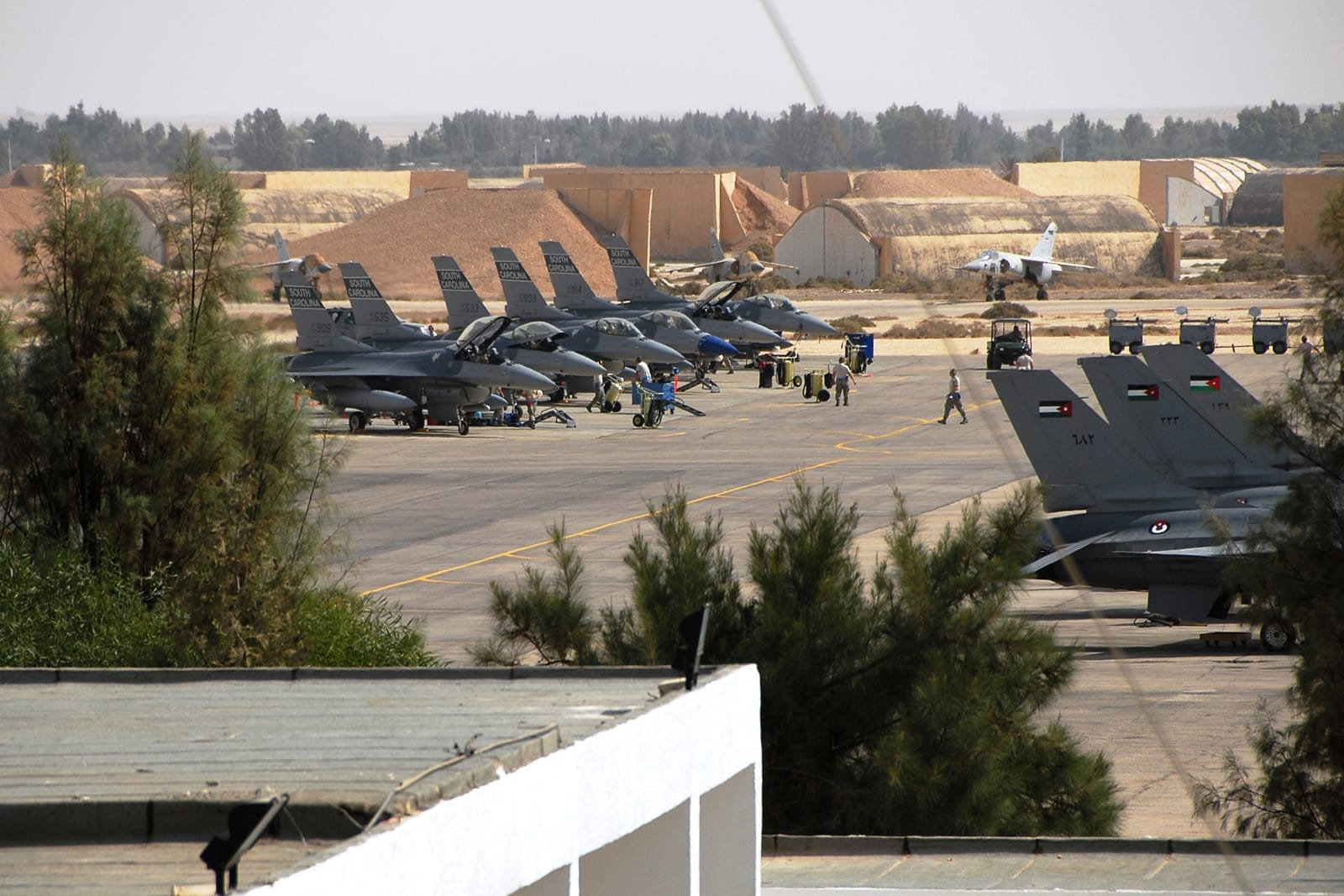
Early Monday the Guard fired ballistic missiles at King Hussein Air Base and Al Azraq air base in Jordan, both of which host American forces. Jordan's armed forces said they intercepted eight missiles and reported no casualties. The Guard claimed it caused damage. Two claims, two governments, neither independently verified: the interception count is Jordan's, the damage claim is Tehran's.
The war started on February 28. Roughly 20 percent of the world's seaborne oil normally moves through the strait. Trump has repeatedly said the strait is open, citing 24 vessels in a week; a multinational coalition overseen by the American Navy said Sunday that traffic remains reduced. Brent traded around $90.90 a barrel Monday, up roughly 3 percent.
A strait carrying a fifth of seaborne oil does not need to close to work as a weapon. It only needs to be uncertain.
The Casualty Record Is Three Claims, and They Do Not Resolve into One
The Associated Press reported Monday on an analysis by Airwars3, a London-based conflict monitor, of the Precision Strike Missile, a Lockheed Martin weapon that detonates in midair and throws tens of thousands of dense metal pellets outward. Airwars mapped strikes on Lamerd in southern Iran on February 28, the war's opening day, and found civilians killed as far as 50 meters from the detonation point, with damage documented about 170 meters out, at a school. Iranian officials say those strikes killed at least 21 civilians, 7 of them children. Central Command denies it, telling the Associated Press that American forces did not launch Precision Strike Missiles or any weapon into Lamerd that day, and suggesting an Iranian missile was responsible.
The record stands in three pieces that do not collapse into each other. The casualty figures are Iranian government claims. The blast pattern analysis is an independent monitor's work. The denial is the Pentagon's, and it denies the strike rather than explaining the pattern.
The Intercept published a related essay, not a news report4, arguing the war has produced a lasting environmental catastrophe. Its underlying citations are solid: the Conflict and Environment Observatory counted more than 300 incidents of potential environmental harm across 12 countries by March, and the Climate and Community Institute put emissions from the first 14 days of strikes at roughly 5 million metric tons. Its closing move, reasoning from Iraqi cancer data to Iran, is an inference, not a measurement.
The Sanctions Campaign Is, so Far, One Proposed Rulemaking
Treasury Secretary Scott Bessent told the Associated Press on Sunday5, ahead of the Group of Twenty finance meetings he is hosting in Asheville, North Carolina, that the administration will sanction another bank this week. "This is going to be financial violence if we have to," he said, and told Reuters to expect new secondary sanctions weekly.
Set that against the ledger. The campaign is called Operation Economic Outcast, and its first formal action was a proposed rulemaking, issued Friday, that would cut the Emirati branches of Egypt's second-largest bank, Banque Misr, off from the American financial system. A proposed rulemaking is not a sanction. It is notice that one may follow.
Fortune reported6 that the world has mostly shrugged. Iranian bank branches remained open in Dubai and Abu Dhabi, Pakistan said it is not obliged to honor unilateral sanctions, and China, which analysts at China Beige Book put at 90 percent of Iran's oil exports, issued a warning rather than a concession. Financial violence announced weekly and delivered once is a communications strategy with a Treasury letterhead, and the test of that arrives this week or not at all.
A 25-Year Concession, Signed by a Government Nobody Elected
The story that got the least attention relative to its size ran Friday. Trump announced that the United States has entered a joint venture giving it control of about 65 billion barrels of Venezuelan oil reserves and said it would substantially lower gas prices.
Reuters reported the terms7: at least 25 years, a 55 percent American stake, $100 billion in secured investment, 17 oil fields including 8 large blocks in the Orinoco Belt, and about $209.3 billion in royalties and taxes to Venezuela, roughly $19 a barrel. The deal skipped competitive bidding and has no published contract text; an Associated Press account described 100-year field rights, a conflict with the 25-year term that remains unresolved. Reuters found the experts it reached unconvinced: Francisco Monaldi of Rice University's Baker Institute called the announced taxes incredibly low, and a Venezuelan law professor said the agreement can still be challenged in court despite formal American recognition.
The political context belongs in the frame. Nicolás Maduro was arrested by the United States in January and is in custody in New York, and Venezuela is led by an acting president, Delcy Rodríguez, who was not elected to the office and who negotiated this agreement. NPR's assessment8, against the president's claim, is that the deal will not lower gas prices.
A 25-year concession over a nation's principal asset, signed by an unelected government installed after the American capture of its predecessor, is a structural fact rather than a news cycle. It will still be operative in 2051.
Nepal's Toll Doubled Overnight, and the Number Is Still a Floor
Nepal's National Disaster Management Authority said Monday that 903 bodies have been recovered and 4,247 people are listed missing, while Xinhua reported at least 16 killed and 546 missing on the Tibetan side: at least 919 dead and more than 4,700 unaccounted for9. Both counts roughly doubled from Sunday's figures, which makes Monday's number a floor rather than a total.
The cause was not ordinary rain. Scientists studying satellite images found that bedrock beneath a Himalayan glacier gave way and took part of the glacier with it, in a rockfall that registered as a magnitude 5.2 earthquake. Warnings went out to mobile phones10 early Sunday, and Xinhua says a crater upstream still holds an estimated 1.4 million cubic meters of water.
Nepal's foreign minister, Shisir Khanal, said that despite contributing one tenth of one percent of global emissions, Nepalis have become major victims of climate change. Scientists quoted by the Associated Press said it is too early to tie this collapse directly to warming, while noting that warming raises the odds of such events.
Renaming a Lake Is the Cheap End of a Trade War That Already Collapsed
Trump signed an executive order on August 27 directing the federal government to call Lake Ontario by the name Lake America, and on Saturday Google became the first major mapping provider to comply11, citing the federal Geographic Names Information System. WIRED noted the tell12: that database's own map still showed Lake Ontario as of Sunday. Google moved ahead of the government record it cited as its reason. MapQuest refused.
Ontario Premier Doug Ford answered with a 24 by 12 foot sign13 near Grimsby reading "Lake Ontario, Now and Always." Wendat Nation Grand Chief Pierre Picard said it is unacceptable for a president to eradicate his nation's history. The name predates both Canadian Confederation and the American Declaration of Independence14. Representative Debbie Dingell plans to introduce a bill to nullify the order and says more than 100 House Democrats15 signed a letter urging a different approach to Canada, a count that is her claim.
The substance under the joke is a collapsed negotiation. Trade talks broke down last week, and Canada has announced retaliatory tariffs taking effect next month against a 50 percent American tariff on Canadian steel. The Guardian reported16 the deal fell apart after Commerce Secretary Howard Lutnick objected to the scale of proposed tariff cuts on steel, aluminium and cars, sectors he controls through national security authority that cuts across Trade Representative Jamieson Greer's portfolio. Overnight Trump posted that the United States loses more than $60 billion a year with Canada. That figure is his claim, not a verified balance.
Credentials Are Now Discretionary, and so Is a Broadcaster's Standing
The Treasury Department denied credentials to individual reporters17 from The New York Times, The Wall Street Journal and Bloomberg News for the G20 finance meetings, and has not explained the decision. Bessent told the Associated Press it has "nothing to do with point of view." Among those denied was Alan Rappeport, who has covered these meetings for the Times since 2017, while the paper's Berlin bureau chief was accredited.
The same weekend, Trump said NBC's Kristen Welker should face rebuke or punishment from the Federal Communications Commission after she described his primary endorsement record as mixed, and said he hoped the commission's chairman would take the threat seriously. A president asking a regulator to punish a broadcaster over an accurate adjective is not a marginal press freedom story. It is the entire category.
The Consumer Bureau Now Asks Companies Politely, and the Results Are In
ProPublica published the clearest look yet18 at what the Consumer Financial Protection Bureau has become. After courts blocked Russell Vought's attempt to shut the bureau down, he changed method rather than goal.
In July testimony he held up the rent-payment fintech Bilt as proof the collaborative approach works. When Bilt's card relaunch went wrong in February, with customers reporting rent paid late or twice and frozen cards, the bureau sent no examiners and opened no investigation. Political appointees met the company, took its documentation, and said Bilt appeared to be back on track. About two weeks after that testimony, nearly 1,900 Bilt customers received mistaken debt collection notices.
The numbers behind the method: one enforcement action since Trump took office, ending in a consent decree with a civil penalty of $1. A current staffer told ProPublica that policy attorneys fell from 40 or 50 to 5 and examination time was cut from 8 weeks to 3, a figure that comes from an unnamed source.
Twenty-Seven Years on Death Row for a Killing the State Now Says Never Happened
ProPublica also published, with Verite News, the story of Jimmie Duncan19, who spent 27 years on Louisiana's death row for a killing the state's own Supreme Court concluded in June never happened as charged. The bite marks that were the only physical evidence could not have been made by a human. Chief Justice John Weimer compared the prosecution to seventeenth century witch trials.
Duncan is 57, spent almost 20 years in solitary confinement, and now works nights at Walmart for $17 an hour. He is not eligible for Louisiana's exoneree compensation, capped at $480,000, until the district attorney declines to retry him or a jury acquits him, a decision due by June 2027. "I am one hundred percent factually innocent," Duncan said, "but not one hundred percent free from prosecution."
A Governor Who Never Answers Can Make an Interstate Warrant Disappear
Minnesota Attorney General Keith Ellison is suing Texas Governor Greg Abbott to compel the extradition of Christian Castro, an Immigration and Customs Enforcement officer charged in Minneapolis with four counts of assault for allegedly firing through a closed door in January and striking a Venezuelan man.
Federal Judge Fernando Rodriguez Jr. declined to intervene on August 27, finding the case not ripe20 because Abbott has not actually denied the request, and noting that no federal law sets a deadline for a governor to decide. Castro was released on August 22 at his 90-day detention limit and cannot be rearrested in Texas without Abbott's agreement, and Abbott says he has serious doubts Castro qualifies as a fugitive. The mechanism matters more than the case: refusal is reviewable, and silence is not.
The Election-Rules Story Got Less Coverage Than the Ads About It
With 64 days to the midterms, PolitiFact documented21 the Republican strategy of running on transgender issues in seven competitive races, and rated several of the ads False, one of them generated by artificial intelligence.
The polling underneath is mixed and worth holding honestly. Gallup found 69 percent of American adults think transgender athletes should play only on teams matching their birth sex, and Pew found 56 percent support banning transition-related medical care for minors. A recent Fox News poll found voters trust Democrats more than Republicans on the issue by 13 points, while ranking the economy first by a wide margin. Both are true at once: the issue polls badly for the left and does not appear to be moving votes.
The harder election story drew less attention. On August 24 the Supreme Court, in an unsigned order22 over the dissent of its three liberal justices, paused a ruling that had blocked key parts of Trump's March executive order on mail voting in 23 Democratic-led states and Washington, D.C. That order directs Homeland Security to build state lists of adult citizens and limits Postal Service delivery of mail ballots to people on them. District Judge Indira Talwani had ruled in June that the president overstepped, because the Constitution assigns that power to state legislatures and Congress, and Justice Ketanji Brown Jackson wrote that the pause needlessly injects chaos into the midterms. Voting begins within weeks and the rules are not settled.
Debt Written off at the Top, Collected at the Bottom
Jacobin ran an argument this weekend23 whose numbers survive separation from the argument. The federal government wrote off about 92 percent of the $793 billion it lent through the pandemic-era Paycheck Protection Program, much of it on a one-page form requiring no proof of necessity, with researchers estimating roughly $64 billion of that lending was fraudulent, an estimate rather than an audited figure. Over the same span, the Supreme Court struck down roughly $400 billion in student debt relief, collections resumed in May of last year, and within a year 20.5 percent of borrowers with a payment due were 90 or more days delinquent, with about 2.2 million people seeing credit scores drop more than 100 points. The SAVE repayment plan was terminated on July 1.
Attach that to wages. A second Jacobin essay24 argues the real threat from artificial intelligence is de-skilling and wage suppression rather than mass unemployment, and WIRED put a number next to it25: Glassdoor found insurance claims adjusters who mention artificial intelligence in reviews are negative about it 98 percent of the time, the most negative group in its sample. Sector employment fell 21 percent between May of last year and May of this year, per the Bureau of Labor Statistics, and entry-level postings are down 50 percent since 2025.
Also This Week
Starbucks. Starbucks Workers United launched a boycott on August 25 over the failure to reach a first contract. More than 700 stores have won union elections since 2021, and judges and the National Labor Relations Board have found more than 500 labor law violations by the company. A documentary on the campaign, Baristas vs Billionaires, is screening now26.
Encryption in the supply chain. Researcher Matt Burch presented nine vulnerabilities in CryptoPro Secure Disk27, a German disk encryption product, at Black Hat and Defcon. Exploited, they would have given full access to encrypted devices. The software ships inside some automated teller machines, including in Diebold Nixdorf's security suite, which says only two of the nine touch its product. The bugs are patched; the problem is propagation, since the vendor does not publish update notes publicly.
A deportation the border czar calls routine. Immigration and Customs Enforcement arrested and, one day later, deported the British commentator Milo Yiannopoulos, a vocal supporter of mass deportation. Tom Homan denied preferential treatment, saying Yiannopoulos had overstayed a visitor visa and received a final removal order on July 22. That account is Homan's.
The Grand Canyon lost its water supply. A flash flood tore through Bright Angel Creek on Saturday, killing a 46-year-old man whose body was recovered Sunday and leaving roughly 15 people missing, a count that moves between 14 and 15 across ABC News, TIME and the Guardian28. The flood destroyed the only water pipeline serving the South Rim, which serves 6 million visitors a year and about 1,600 residents, so the park has barred overnight lodging while storage tanks cannot be refilled. A $208 million rehabilitation of the pipeline began in 2023 and was due to finish next year; nobody has costed what the flood did to it.
Iceland. Icelandic voters rejected restarting European Union accession talks29 by 52.8 percent to 47.2 percent, per Iceland's National Electoral Commission, in a referendum CNN framed as held in the shadow of Trump's threats toward Greenland. A small North Atlantic country looked at an administration talking openly about acquiring Arctic territory and at a bloc offering membership, and chose neither.
What Would Settle These Questions This Week
Whether Treasury sanctions a named bank, or whether the Banque Misr rulemaking remains the whole of Operation Economic Outcast. Whether the strike and counterstrike cycle between Larak Island and the Jordanian air bases holds or climbs. Whether Nepal's missing count resolves downward or upward. Whether the Venezuelan contract terms are ever published, and whether any named American oil company signs. Whether Dingell's bill draws a single Republican cosponsor. Whether Abbott ever answers Minnesota. And whether the mail voting pause produces concrete changes at the Postal Service before the first ballots go out.
The Coverage Gap
Two directions, both worth stating.
What conservative outlets carried that left and independent outlets did not. National Review ran two pieces on federal debt and interest costs, and the numbers hold up: net interest through July of this fiscal year came to $931 billion, up 11 percent year over year, the third largest line in the federal budget behind Social Security and Medicare, with the Congressional Budget Office projecting a rise from about $1 trillion this year to $2.1 trillion by 2036, per the Peter G. Peterson Foundation's tracker updated August 13, 2026. Left and independent outlets covered oil, tariffs and grocery prices this weekend and connected none of it to the debt service line, which is the constraint every spending argument eventually meets. The Dispatch flagged Saudi Arabia winding down its LIV Golf investment, a data point on how the Public Investment Fund reallocates in a high-rate environment. National Review also ran a critique of European Union digital independence policy; left and independent coverage of digital sovereignty this weekend ran almost entirely from the American side, and that self-critique is worth having on file even where its conclusion is wrong.
What conservative outlets ran as narrative rather than reporting. The New York Post relayed a report claiming Democratic Socialists of America proposals would cost $200 trillion over a decade and are closer to Soviet-style communism. That figure comes from a partisan report and is a campaign artifact, not a costing. The Washington Examiner called campus activists useful idiots for a dead Soviet empire, and argued elsewhere that Iran is a pressure cooker rather than a forever war. Fox News amplified a Maine Medicaid audit as a fraud scandal with the vice president attached. The Daily Wire ran the Lake America story as liberal hysteria. None of these are coverage gaps. They are the framing that arrives secondhand over the following weeks.
What left and independent outlets carried that conservative outlets ignored entirely. The Airwars analysis of Precision Strike Missile casualties in Lamerd appeared nowhere on the right. Neither did the Intercept's environmental accounting of the war. ProPublica's finding that the Consumer Financial Protection Bureau has brought one enforcement action with a $1 penalty was absent, as was Jimmie Duncan's exoneration after 27 years on death row. Treasury blocking reporters from three newspapers at the G20 drew no conservative coverage, including from outlets that spent the last decade on press freedom when the target was friendly. Rebecca Solnit's column on the proposed Yosemite land sale, an opinion piece and thin on specifics, points at a public lands story the right is not covering at all.
What the left-of-center press did to itself. Left and independent feeds this weekend were heavy on Trump's political weakness. AlterNet alone ran more than a dozen pieces on Republican panic, a prairie fire in the Senate map, and the president losing his grip on attention, nearly all of it sourced to anonymous insiders in other outlets rather than to original reporting. That is the mirror image of the narrative tier on the right and deserves the same discount. The reported stories this weekend were a war, an oil concession, a flood, and a consumer protection agency. The vibes stories were the midterms.
Two structural habits are visible in both directions. Volume is not coverage: a dozen pieces restating one anonymous quote is one story, and counting it as twelve inflates a beat that produced nothing new. And a war covered only as a war misses most of what it is. For six months the Iran conflict has been reported as strikes and retaliations, while its most durable effects register as a price on a barrel, a shipping insurance rate, and a bank's access to dollar clearing.
Method
This review is built from a daily briefing assembled by an automated pipeline, then rewritten for publication.
Feeds and window. 24 RSS feeds, of which 23 resolved; the NPR feed failed on malformed XML. 128 body items and 87 detection items were staged over a 36-hour window, and two outlets returned nothing inside it.
Source weighting. Bodies for 25 selected articles were read in full. Reuters, the Associated Press, The Atlantic and WIRED are headline and summary only by pipeline design. One Jacobin essay hit a registration wall and is not used here; a second returned a condensed render, and only its stated thesis is used.
Live fact-check. Every figure, date, toll, price and officeholder was checked against live search rather than taken from the staged feed text.
Attribution discipline, one standard. A government's claim about casualties, damage, interceptions or fraud is attributed to the government that made it, regardless of which government. That rule produced the Lamerd casualty figures as Iranian claims, Central Command's denial as the Pentagon's, the interception count as Jordan's, and the damage claim as Tehran's. Opinion columns and analysis essays are labeled as argument, never presented as reported fact.
Corrections in this edition, by class. Five judgment calls: Nepal's toll and missing count roughly doubled overnight, and the newer figures are used and called a floor; the staged feeds ended the Iran story at "Iran vows retaliation," while a live check confirmed the strikes on two Jordanian air bases; stale Sunday oil closes were replaced with Brent at about $90.90; Bessent's "we will sanction another bank" framing was reduced to its verifiable core, a proposed rulemaking; and the Venezuela story was headline-only in the stage until live reporting established its terms and political context.
Eight mechanical corrections, among them: the Grand Canyon missing count given as a range rather than a single figure; the mail-voting item moved off opinion-page framing onto the August 24 order itself; Federal Reserve framing corrected to market-implied hike probability against a 3.625 percent funds rate; and an unattributed Gaza casualty figure dropped rather than repeated as fact.
Footnotes
29 footnotes, 29 unclassified.
A footnote carrying a classification was authored as a source record. The rest are the edition's own citations as published: outlet and address as they stood, with no classification, attribution posture or reading depth on record.
- 1
PBS NewsHour (opens in a new tab)pbs.org
struck Iranian rocket launchers
- 2
The Hill (opens in a new tab)thehill.com
fired ballistic missiles
- 3
Local 10 News (opens in a new tab)local10.com
The Associated Press reported Monday on an analysis by Airwars, a London-based conflict monitor, of the Precision Strike Missile, a Lockheed Martin weapon that detonates in midair…
- 4
The Intercept (opens in a new tab)theintercept.com
essay, not a news report
- 5
PBS NewsHour (opens in a new tab)pbs.org
told the Associated Press on Sunday
- 6
Fortune (opens in a new tab)fortune.com
Fortune reported that the world has mostly shrugged.
- 7
Investing.com (opens in a new tab)investing.com
Reuters reported the terms: at least 25 years, a 55 percent American stake, $100 billion in secured investment, 17 oil fields including 8 large blocks in the Orinoco Belt, and…
- 8
NPR (opens in a new tab)npr.org
NPR's assessment, against the president's claim, is that the deal will not lower gas prices.
- 9
ABC News (opens in a new tab)abcnews.com
at least 919 dead and more than 4,700 unaccounted for
- 10
PBS NewsHour (opens in a new tab)pbs.org
Warnings went out to mobile phones
- 11
404 Media (opens in a new tab)404media.co
Google became the first major mapping provider to comply
- 12
Wired (opens in a new tab)wired.com
WIRED noted the tell: that database's own map still showed Lake Ontario as of Sunday.
- 13
PBS NewsHour (opens in a new tab)pbs.org
answered with a 24 by 12 foot sign
- 14
PBS NewsHour (opens in a new tab)pbs.org
predates both Canadian Confederation and the American Declaration of Independence
- 15
The Guardian (opens in a new tab)theguardian.com
says more than 100 House Democrats
- 16
The Guardian (opens in a new tab)theguardian.com
The Guardian reported the deal fell apart after Commerce Secretary Howard Lutnick objected to the scale of proposed tariff cuts on steel, aluminium and cars, sectors he controls…
- 17
PBS NewsHour (opens in a new tab)pbs.org
denied credentials to individual reporters
- 18
ProPublica (opens in a new tab)propublica.org
ProPublica published the clearest look yet
- 19
ProPublica (opens in a new tab)propublica.org
the story of Jimmie Duncan
- 20
The Texas Tribune (opens in a new tab)texastribune.org
finding the case not ripe
- 21
PBS NewsHour (opens in a new tab)pbs.org
With 64 days to the midterms, PolitiFact documented the Republican strategy of running on transgender issues in seven competitive races, and rated several of the ads False, one of…
- 22
NPR (opens in a new tab)npr.org
On August 24 the Supreme Court, in an unsigned order over the dissent of its three liberal justices, paused a ruling that had blocked key parts of Trump's March executive order on…
- 23
Jacobin (opens in a new tab)jacobin.com
Jacobin ran an argument this weekend
- 24
Jacobin (opens in a new tab)jacobin.com
A second Jacobin essay argues the real threat from artificial intelligence is de-skilling and wage suppression rather than mass unemployment, and WIRED put a number next to it:…
- 25
Wired (opens in a new tab)wired.com
WIRED put a number next to it
- 26
The Guardian (opens in a new tab)theguardian.com
A documentary on the campaign, Baristas vs Billionaires, is screening now.
- 27
Wired (opens in a new tab)wired.com
nine vulnerabilities in CryptoPro Secure Disk
- 28
The Guardian (opens in a new tab)theguardian.com
A flash flood tore through Bright Angel Creek on Saturday, killing a 46-year-old man whose body was recovered Sunday and leaving roughly 15 people missing, a count that moves…
- 29
PBS NewsHour (opens in a new tab)pbs.org
rejected restarting European Union accession talks