Issue 28 of The Open Record
The Fight Is Over the Machinery, and the Courts Are Only Buying Time
A Postal Service rule that reroutes mail ballots, two Florida jails that reset a 72-hour detention clock by rebooking the same people, and a Pentagon blacklist a federal judge called illegal and baseless: this week's fight is over who holds the controls.
Daily news review for Friday, August 28, 2026. Every source is footnoted. A note on method is at the bottom.
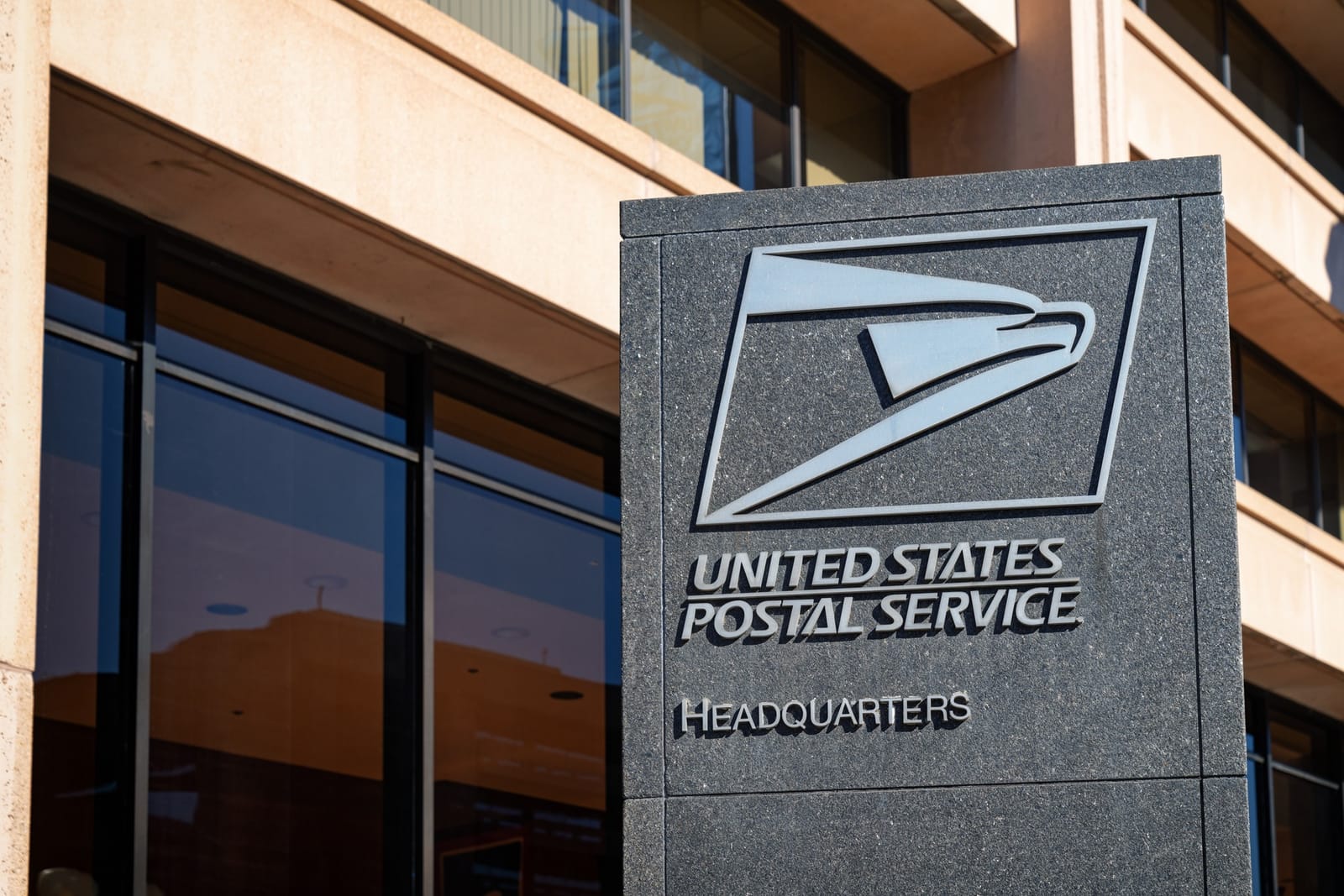
_Headquarters_in_Washington_D.C._(53830674849).jpg)
0% read, about 20 min remaining
The through-line today is machinery. Not rhetoric, machinery. Who controls the postal system that carries a ballot, the jail that holds a body, the camera that logs a license plate, the procurement list that decides which company gets to sell to the government. Story after story, the fight is over which hands are on the switches and how fast a court can pull them back.
Federal judges ruled against the administration twice in the last day, on voting and on a technology blacklist, and a third pressed the government in open court over the renaming of a building. None of those rulings settled anything. They bought time, and time is the scarce commodity a week before mail ballots go out.
A Procedural Ruling with a Substantive Effect
On Monday the Supreme Court, in a 6-3 decision, lifted a lower court block on President Trump's March executive order restricting mail voting. The majority did not rule on whether the order is legal. It ruled that the states challenging it had sued too early, before the order had done anything concrete to them. Justice Ketanji Brown Jackson dissented, writing that the decision would produce a "Kafkaesque nightmare" and "needlessly injects chaos and uncertainty into the midterm elections." The case is Trump v. California, 26A124, decided August 24. It is a procedural ruling with a substantive effect: the order stands because nobody has been hurt by it yet, on the Court's reckoning, which means the injury has to arrive before the remedy can.
The injury arrived fast. The Postal Service issued a rule saying it will not deliver a state's mail ballots unless that state hands over a list of voters who should receive them and formats the envelopes a particular way. The plaintiffs refiled. On Thursday, federal district judge Indira Talwani placed a 14-day hold on implementation1 on logistical rather than constitutional grounds: the states have neither the time nor the funds to redesign ballots, retrain officials, and upload voter data to a new federal portal before the midterms. A hearing is set for September 3, an appeal is considered likely2, and the case is probably headed back to the Supreme Court.
Nearly one third of Americans vote by mail, and a 2025 Brookings Institution report found mail voting fraud at roughly four cases per 10 million ballots cast. The stated problem is a rounding error. The remedy reroutes the physical delivery of ballots through a federal agency that answers to the executive. Quinnipiac University law professor John J. Martin, in a Q&A published by AlterNet and The Conversation3, argues there is no clear constitutional source for presidential authority over election administration, since the Constitution assigns that power to the states and in some cases to Congress. That is a contested argument rather than a settled question, but it is the one the Court will have to answer on the merits once the postal rule bites.
Civil rights organizations march in Washington today, on the 63rd anniversary of the 1963 March on Washington. The theme is voting rights, and Martin Luther King III, Alexandria Ocasio-Cortez, Bernie Sanders, and Al Sharpton are among those expected.
The 911 Calls Are the Government's Own Record
ProPublica, working with The Texas Tribune, obtained recordings of more than 160 emergency calls4 from Camp East Montana, an immigration detention facility on Fort Bliss Army land in El Paso, Texas. It opened in August 2025. Three detained men died there within roughly six weeks: Francisco Gaspar-Andres, 48, Guatemalan, on December 3; Geraldo Lunas Campos, 55, Cuban, on January 3; and Victor Manuel Diaz, 36, Nicaraguan, on or about January 16.
The calls are the reporting. A month after the camp opened, a nurse told a dispatcher that a man with suicidal thoughts had swallowed a foreign object, was unable to speak, and was rolling on the floor in agonizing pain. In November, a nurse called about a 46-year-old woman with COVID-19 and said the facility had no oxygen for her if her levels dropped further.
A medical examiner ruled the January 3 death of Lunas Campos a homicide. Homeland Security said guards used force to keep him from killing himself, called claims of inhumane conditions "categorically false," and said that for many detainees the healthcare they receive in custody is the best they have ever gotten. Those are the government's characterizations. The recordings are its own emergency traffic. ICE has extended the contract through at least September 30, 2027.
The 72-Hour Clock, and How Two Florida Jails Reset It
ProPublica's second investigation5 is about a clock. Federal rules and local contracts cap how long a county jail may hold someone for immigration authorities at 72 hours, counted in business days. Two Florida jails found a way around it: release detainees, immediately rebook them, reset the count.
Using federal detention data and unredacted booking logs, ProPublica counted 559 people rebooked at least twice in Orange County between July 2025 and early February, and 174 in Pinellas County. Every other jail in the country rebooked no more than 10 people twice or more. Thirty of the Orange County rebookings happened within 15 minutes, five within a single minute, and one woman was rebooked 10 times for a cumulative 26 days. Of those rebooked at least twice through December, 27 percent had no charges or convictions beyond traffic offenses.
Stanford law professor Jennifer Chacon told ProPublica there is no argument that this is lawful detention, and a federal judge in Orlando, Paul Byron, called resetting the clock artificially "wildly inappropriate" from the bench. Homeland Security said ICE is not breaking any laws and makes custody determinations based on bed space, which is a position rather than a legal citation.
Note the asymmetry in how it ended. Majority Democratic Orange County stopped after public pressure in February. Republican led Pinellas did not. It switched to longer single stays.
A Stillbirth, a Denial, and the Medical Records
Iris Dayana Monterroso Lemus, a 38-year-old Guatemalan woman, had a stillbirth at roughly 23 weeks in immigration custody in Louisiana last year. When her account was first published, Homeland Security called the reporting "absolutely false" and said she had received full prenatal care including an ultrasound and an obstetrics visit.
Newly obtained medical records6, reported by The Intercept, describe her pregnancy as complicated by lack of prenatal care. The timeline shows a referral but no documentation that a visit or an ultrasound happened. What it does show is use of a fetal doppler, an audio heartbeat check that an obstetrician quoted by The Intercept said is not an ultrasound. She was deported to Guatemala 10 days after the delivery, which ended her follow-up care.
A Procurement Weapon Aimed at a Critic
A federal judge ruled Thursday that the Pentagon's blacklisting of the AI company Anthropic was unlawful retaliation7. Judge Rita Lin, in a 59-page decision, overturned Defense Secretary Pete Hegseth's designation of the company as a supply chain risk and barred the named agencies from enforcing it. The "empty invocation of national security," she wrote, "is not a blank check to punish and retaliate against government critics."
The designation followed the company's refusal to let the military use its model for domestic surveillance or autonomous weapons. The government's position in filings is that it stemmed from a refusal to accept contractual terms rather than from the company's safety commitments, and that private firms should not constrain military operations. Both can be true at once: a company drew a line the Pentagon found intolerable, and the Pentagon reached for a procurement weapon built for foreign sabotage risk to punish it. The Guardian reports this was the first time an American company was publicly designated that way. The government may appeal.
Data Centers Are Splitting the Labor Movement
Jacobin has the sharpest account8 of the data center fight now dividing organized labor. That piece is argument rather than neutral reporting. The reported facts underneath: opposition to local data centers rose from 49 percent in March to 61 percent in July in University of Pennsylvania polling, and an August Heatmap survey put it at 75 percent, both figures Jacobin's citations. Building trades unions back the projects as a rare source of well paid union construction work in a sector roughly one third union, about three times the industry average. National Nurses United and the American Association of University Professors have endorsed the Sanders and Ocasio-Cortez moratorium bill.
Jacobin's argument is that a moratorium lands its whole cost on construction workers while white collar AI work continues, and that the trades should trade their control over whether the infrastructure gets built for enforceable guardrails instead. That is a real strategic disagreement inside the left rather than a scandal, and it will define labor politics in several states this cycle.
The Guardian adds the least discussed harm. In Vineland, New Jersey, three residents are suing over noise from a 350-megawatt data center9, alleging the sound is a nuisance for up to a mile around the site; their lawyer has four such cases in litigation. Congress tasked the Environmental Protection Agency with regulating noise in 1972, the Reagan administration defunded the noise offices in 1982, and enforcement has been dead since. Forty-four years of nonenforcement is colliding with a construction boom, and the courts are the only venue left.
The Flock Backlash Is Bipartisan, and That Is the Story
The backlash to Flock Safety's license plate camera network is genuinely cross-partisan, one of the few places where left and conservative outlets describe the same problem in nearly the same words.
404 Media obtained a 43-page internal affairs file10 from the Brevard County Sheriff's Office in Florida on deputy Michael Fultz, named the agency's Deputy of the Year in 2025. According to that file, he used the Flock network from his agency issued phone to run his ex-girlfriend's vehicle registration while off duty, and the audit logs caught it. The file also describes photographs in which he had shaved his mustache to resemble Hitler and performed a Nazi salute, racial slurs in text messages, and photographic evidence from the ex-girlfriend of him holding his firearm to her head, all allegations recorded in an internal investigation. Investigators concluded termination was warranted; he had already resigned.
Republican Senator Josh Hawley of Missouri has opened a Senate Judiciary subcommittee investigation into the company. Writing in his own words in The Daily Wire11, he cites more than 120,000 cameras nationwide, roughly 20 billion snapshots a month, a Milwaukee officer who searched a girlfriend's plate 124 times while typing only the word "investigation" in the justification field, and a California department where 71 percent of alerts were wrong. Those are his figures and his framing, and his conclusion is one the left will recognize from the other direction: rules protecting Americans should be set by law and by the people, not by venture capital funds and technology executives.
Wired reported on how one Atlanta suburb ended up sharing its Flock data with more than 2,000 organizations12, and Vox covered the coalition forming against the company13. Both were unreachable for this review and are cited on headline only.
Fifty Cents an Hour, and the Algorithm Is the Manager
Yale researcher Julian Posada, whose forthcoming book is called Platform Extractivism, described fieldwork among Venezuelan data workers14 who trained AI systems during the height of the pandemic. The figures are his own. The platform Remotasks paid about 50 cents an hour; most platforms paid by the task, and workers earned roughly $2 to $5 a week against hyperinflation. Some used VPNs to disguise their Venezuelan addresses and get paid more for identical work. The chain ran from client company to outsourcing firm to platform to worker, and workers generally did not know who they were labeling for.
Posada is direct about the mechanism: the algorithm is the manager. Timers, accuracy scoring, duplicate tasks planted to catch cheating, bans. He says the work shifted after 2023 toward English speaking countries, naming the Philippines and India, following what he calls a colonial legacy15. If there is one sentence for what the current AI boom rests on, that is it, and it is a sentence about labor arbitrage rather than about models.
Meta's Settlement Buys Limits, Not Rules
Meta agreed on Wednesday to pay at least $12 billion and up to $17 billion16 to settle state claims that it designed its products to be addictive and harmful to children. The suit was brought by 29 states led by California, and the additional $5 billion is owed only if Snap, TikTok, and YouTube reach similar agreements. Meta also agreed to limit users under 18 to two hours a day, silence notifications during school hours, and block access from midnight to 6 a.m.
Amba Kak of the AI Now Institute called the settlement welcome and insufficient, noting it works out to roughly $17 billion across 10 years, and argued that fines after the fact cannot substitute for rules aimed at the surveillance advertising model itself. Former Facebook employee Arturo Bejar put it harder: the limits amount to saying you can smoke as many cigarettes as you can in two hours a day, and that does not make the cigarettes any safer.
Six Months of the Iran War, and a Dispute over What It Consumed
Trump's war with Iran hits six months today, and the Associated Press has an exclusive on what it has cost in materiel17. Citing an American defense official in Europe and a NATO official, both anonymous, the AP reports a "beyond critical" shortage of advanced missile interceptors there, with stocks moved to the Middle East and American forces in Europe lacking enough Patriots to stop a sustained ballistic missile attack. The Center for Strategic and International Studies estimates the conflict has consumed 65 percent of American Patriot inventory, roughly 1,500 of 2,330 interceptors.
The on-record denials are equally part of the record. NATO's senior military spokesman, Army Colonel Martin O'Donnell, said it is simply not the case that Patriot numbers are beyond critical, and chief Pentagon spokesman Sean Parnell said claims of munitions shortages are false. The honest statement is that anonymous officials and a think tank say the cupboard is bare, named officials say it is not, and both cannot be right. What is not in dispute is that the CIA director traveled to Moscow this week to warn Russia not to attack, a strange errand to run if the shelves are full.
The war is also on the ballot in Michigan, where Jacobin, again arguing rather than reporting neutrally, documents Republican Senate candidate Mike Rogers pushing for war with Iran across two decades18, including a 2006 subcommittee report asserting an Iranian nuclear weapons program that the International Atomic Energy Agency publicly rebuked. Jacobin says the war is costing Michigan more than $2 billion and West Michigan families $15 to $20 a week more for gas, figures the outlet gives without a named source study.
The Tariff Escalation Lands First in Detroit
Trump announced Monday that tariffs on Canadian automobiles, auto parts, steel, and trucks will double from 25 percent to 50 percent on January 1, 2027. Some coverage described this as 50 percent on Canadian goods generally; the verified scope is autos, auto parts, steel, and trucks. Canada answered Tuesday with retaliatory tariffs of up to 50 percent on about $27.6 billion of American goods, effective September 8, matching, in Finance Minister Francois-Philippe Champagne's words, dollar for dollar and rate for rate.
The Guardian went to Detroit for what that means on the ground19. A billion dollars in goods crosses the river between Detroit and Windsor every day, and auto parts cross a border an average of six times before ending up in a finished product. A June Epic-MRA poll found Michigan residents opposed to Canadian tariffs 63 to 31, including 35 percent of Republicans. The United Auto Workers, 350,000 members strong in the state, has backed some targeted tariffs but rejects this escalation; President Shawn Fain's position is that tariffs work only when aimed at protecting workers. The Detroit chamber of commerce, not a left wing institution, said escalation will only cause pain on both sides of the border.
On Thursday Trump signed an executive order directing the Interior Department to rename Lake Ontario as Lake America. New York Governor Kathy Hochul says her state will not follow it, and Canadian Prime Minister Mark Carney noted that the name comes from a Wendat word predating both Canadian Confederation and the American Declaration of Independence. Vox argued in an opinion newsletter that the renaming is not the joke it looks like20.
Two Disasters Where the Numbers Are Still Moving
The Himalayan flood disaster on the Nepal and Tibet border is still growing, and the figures conflict enough that a range is more honest than a number. Nepali police put the confirmed dead above 470 as of Friday morning21, and Reuters reported the combined toll topping 500. More than a thousand people remain missing, including hundreds of foreign tourists from more than 30 countries, and estimates of missing Americans range from 65 to about 90 depending on the outlet. The cause, according to the United States Geological Survey22, was a glacier collapse at roughly 5,200 meters; initial reports blamed an earthquake, but the Survey concluded the seismic signal came from the landslide itself. A newly formed barrier lake has threatened a second deluge, and rescue work resumed Friday after that threat eased.
In Congo, the health ministry has begun Ebola vaccinations23 against what the health minister calls the country's worst outbreak on record. As of mid-August the ministry counted 5,021 cases and 2,378 deaths, a case fatality rate near 47 percent. Those are the Congolese government's figures; health officials quoted by NPR24 say the true size could be up to three times the confirmed count. The variant is Bundibugyo, spreading roughly three times faster than the 2014 West African outbreak.
Also This Week
A criminal referral over Samoa. Senator Ron Wyden is calling for a criminal investigation of Health Secretary Robert F. Kennedy Jr., following Guardian reporting based on letters obtained through a FOIA lawsuit25. Kennedy testified at two confirmation hearings that his 2019 Samoa trip had nothing to do with vaccines; one newly released letter has him telling the Samoan prime minister he wanted to study the measles, mumps, and rubella vaccine there, using the word vaccine or vaccination eight times. Months after that trip a measles outbreak killed 83 people in Samoa, mostly children under five. Health and Human Services says the claim that Kennedy lied is false and defamatory. A Georgetown law professor quoted by the Guardian notes the obstacle: prosecuting a lie to Congress requires this Justice Department to want to.
A seven-acre fire and a 480-acre ranch. Three Democratic senators have asked the Agriculture Secretary to investigate Michael Boren26, the undersecretary overseeing the Forest Service, over Washington Post reporting that he repeatedly pressed officials about aircraft on a fire near his own Idaho ranch. The fire burned seven acres and was contained in three days, and six current and former Forest Service officials told the Post the response exceeded what a fire that size would normally get. The department says Boren never pressured anyone. No investigation has been opened, and the senators asked for an answer by September 10.
Sanctions aimed at a protest network. The administration has sanctioned Palestine Action, the British founded network known for actions at facilities of the Israeli weapons manufacturer Elbit Systems, alongside two other groups, cutting them off from American banking and donations. Britain proscribed Palestine Action as a terrorist organization last year, after which more than 1,200 people were arrested at rallies expressing support. A former spokesman told The Intercept27 the point is to make ordinary Americans afraid to support the group. Whatever one thinks of the tactics, a sanctions instrument built for terrorism financing aimed at a protest network is a precedent unlikely to stay confined to this cause.
A month in a cottonwood. In southern Arizona, The Intercept reports on a tree sit that has held for about a month28 after contractors felled three giant cottonwoods near Lochiel on July 27. The planned barrier is two walls 30 feet high with 60 feet of no man's land between them, running 27 miles through the San Rafael Valley at a cost of about $500 million, in what the Sierra Club's borderlands coordinator calls the most important remaining jaguar corridor in the United States. He says he documented an active bird nest the day before the trees came down; Customs and Border Protection says preconstruction surveys found none. Neither account has been adjudicated.
A name back on a building. A federal judge questioned in court why the Kennedy Center is moving so quickly to return Trump's name to the building29, per PBS NewsHour and the AP, carried here at headline level only. The inscription is dated for September 8, and the open question is whether Judge Cooper finds he has jurisdiction while his own earlier ruling is under appeal.
The Coverage Gap
Setting what conservative outlets carried against what left and independent outlets carried produces a two-way diff, and both directions are instructive.
What the right carried and the left did not.
The bond market and the Federal Reserve is the real gap, and it is the one left and independent outlets reliably underweight. The Dispatch ran on whether the United States can avoid a debt spiral. Breitbart's business digest ran on Fed Chair Kevin Warsh, Treasury Secretary Scott Bessent, and the bond market. Independent confirmation puts a genuine story underneath the framing: Bessent has moved onto the central bank's turf with a direct bond market intervention, and Warsh faces a first real test of Federal Reserve independence. Not one left or independent outlet in this review ran anything on the Fed, Treasury yields, or the debt trajectory. For a politics that reasons from political economy, the institution that sets the price of money is not an optional beat.
Immigration enforcement as litigation is the second gap. Breitbart led with the Justice Department suing four more states over in-state tuition for undocumented students. Mainstream outlets confirm it, and it is the ninth or tenth state in a rolling campaign since early August. Left and independent outlets covered detention conditions in depth and covered this expansion of the legal offensive not at all. Conditions reporting is the harder and better work. It is also the reactive half.
Some of what conservative outlets ran is narrative rather than gap. The Daily Wire and Breitbart both amplified a story that a Canadian broadcaster told staff not to call the September 11 attacks terrorist attacks. Breitbart also ran a claim that 80 percent of fentanyl trafficker arrests in Portland are of migrants from Honduras, sourced to no study that could be located. The Washington Examiner ran an opinion piece alleging doctors are farming humans for organs. That is framing intelligence about what the right is feeding its audience, not coverage anyone failed to match.
What the left carried and the right did not.
The Camp East Montana emergency calls. Three deaths in six weeks at a detention facility on an Army base, one ruled a homicide by a medical examiner, documented through the facility's own 911 traffic. Nothing on the right. Not even a rebuttal.
The Florida rebooking scheme. 559 people in one county cycled through release and immediate rearrest to reset a legal clock, with a federal judge calling it wildly inappropriate from the bench. This is a story about a government agency circumventing its own contractual limits, normally a subject conservative outlets care about. Silence.
The Patriot interceptor shortage. The Washington Examiner, The Daily Wire, and National Review all ran Iran war retrospectives at the six month mark, arguing over whether it is a victory or a quagmire. None ran the AP exclusive on the interceptor stockpile, the one hard logistical fact bearing on the answer. Arguing about whether the war was worth it while skipping what it consumed is a choice, and volume of coverage is not the same thing as coverage.
And a gap on both sides.
The Democracy Now segments on Venezuelan data workers training AI systems for 50 cents an hour appeared nowhere else, left or right. Nobody covers the labor supply chain of the technology both sides spend all day arguing about. That absence is bipartisan. So is the habit of covering the Iran war as a war and never as a price, which is why the interceptor story and the Michigan gas price story are almost never told in the same place.
Method
This review is built from a single automated news pass run on the morning of August 28, 2026, in live fact-check mode.
Feeds and window. Twenty-three of 24 RSS feeds resolved; the NPR feed failed on malformed XML. 152 body items and 92 blindspot detection items were staged over a 36-hour window, and 28 chosen articles were read in full. Wired, Vox, one Drop Site URL, the wire bridges, and The Atlantic were unreachable and are used on headline and summary only, which is stated wherever they appear.
Source weighting. Original reporting outranks aggregation, and documentary evidence outranks characterization. Opinion and analysis pieces are labeled as argument and never presented as reported fact: that applies to Jacobin on data centers and on Mike Rogers, to Senator Hawley's Daily Wire op-ed, to the Vox newsletter on Lake Ontario, and to the Washington Examiner piece named above.
Live fact-check. Every figure, date, toll, and officeholder was checked against live web search rather than model memory. The Supreme Court ruling was confirmed as 6-3, decided August 24, 2026, in Trump v. California, 26A124, against the Court's own opinion PDF and coverage from Votebeat, NPR, NBC, and CNN. The Anthropic ruling was confirmed independently by CNBC, CNN, NPR, Axios, The Hill, and Forbes; the Meta settlement by NPR and PBS NewsHour; the AP Patriot exclusive as carried by France 24 and the Philadelphia Inquirer.
Attribution discipline. Government claims about casualties, medical care, fraud, and enforcement are attributed to the government that made them, one standard regardless of which government is speaking. That covers Homeland Security's characterizations of detention healthcare, the Congolese health ministry's case and death counts, the Nepali police toll, and the on-record NATO and Pentagon denials of the interceptor shortage. Where accounts conflict and nothing has been adjudicated, both are reported as conflicting rather than resolved.
Corrections in this edition. Two judgment calls and four mechanical fixes. First: some coverage described Monday's tariff announcement as 50 percent on Canadian goods generally, and the verified scope is autos, auto parts, steel, and trucks. Second: the Himalayan flood toll varies across outlets on the same morning, from Reuters at 500 or more to Al Jazeera at 470 or more to Nepali police at 469, and is reported here as a range. Separately, the Boren item was corrected from an opened investigation to a request from three senators that one be opened.
Footnotes
29 footnotes, 29 unclassified.
A footnote carrying a classification was authored as a source record. The rest are the edition's own citations as published: outlet and address as they stood, with no classification, attribution posture or reading depth on record.
- 1
The Guardian (opens in a new tab)theguardian.com
placed a 14-day hold on implementation
- 2
The Guardian (opens in a new tab)theguardian.com
an appeal is considered likely
- 3
AlterNet (opens in a new tab)alternet.org
in a Q&A published by AlterNet and The Conversation
- 4
ProPublica (opens in a new tab)propublica.org
obtained recordings of more than 160 emergency calls
- 5
ProPublica (opens in a new tab)propublica.org
ProPublica's second investigation is about a clock.
- 6
The Intercept (opens in a new tab)theintercept.com
Newly obtained medical records
- 7
The Guardian (opens in a new tab)theguardian.com
the Pentagon's blacklisting of the AI company Anthropic was unlawful retaliation
- 8
Jacobin (opens in a new tab)jacobin.com
Jacobin has the sharpest account
- 9
The Guardian (opens in a new tab)theguardian.com
suing over noise from a 350-megawatt data center
- 10
404 Media (opens in a new tab)404media.co
obtained a 43-page internal affairs file
- 11
The Daily Wire (opens in a new tab)dailywire.com
Writing in his own words in The Daily Wire
- 12
Wired (opens in a new tab)wired.com
how one Atlanta suburb ended up sharing its Flock data with more than 2,000 organizations
- 13
Vox (opens in a new tab)vox.com
the coalition forming against the company
- 14
Democracy Now! (opens in a new tab)democracynow.org
described fieldwork among Venezuelan data workers
- 15
Democracy Now! (opens in a new tab)democracynow.org
following what he calls a colonial legacy
- 16
Democracy Now! (opens in a new tab)democracynow.org
pay at least $12 billion and up to $17 billion
- 17
PBS NewsHour (opens in a new tab)pbs.org
an exclusive on what it has cost in materiel
- 18
Jacobin (opens in a new tab)jacobin.com
documents Republican Senate candidate Mike Rogers pushing for war with Iran across two decades
- 19
The Guardian (opens in a new tab)theguardian.com
went to Detroit for what that means on the ground
- 20
Vox (opens in a new tab)vox.com
the renaming is not the joke it looks like
- 21
Al Jazeera (opens in a new tab)aljazeera.com
above 470 as of Friday morning
- 22
Al Jazeera (opens in a new tab)aljazeera.com
according to the United States Geological Survey
- 23
PBS NewsHour (opens in a new tab)pbs.org
begun Ebola vaccinations
- 24
NPR (opens in a new tab)npr.org
Those are the Congolese government's figures; health officials quoted by NPR say the true size could be up to three times the confirmed count.
- 25
The Guardian (opens in a new tab)theguardian.com
Guardian reporting based on letters obtained through a FOIA lawsuit
- 26
The Guardian (opens in a new tab)theguardian.com
investigate Michael Boren
- 27
The Intercept (opens in a new tab)theintercept.com
A former spokesman told The Intercept the point is to make ordinary Americans afraid to support the group.
- 28
The Intercept (opens in a new tab)theintercept.com
a tree sit that has held for about a month
- 29
PBS NewsHour (opens in a new tab)pbs.org
why the Kennedy Center is moving so quickly to return Trump's name to the building