Issue 26 of The Open Record
The State Is Adding Capacity Faster Than It Is Adding Any Check on It
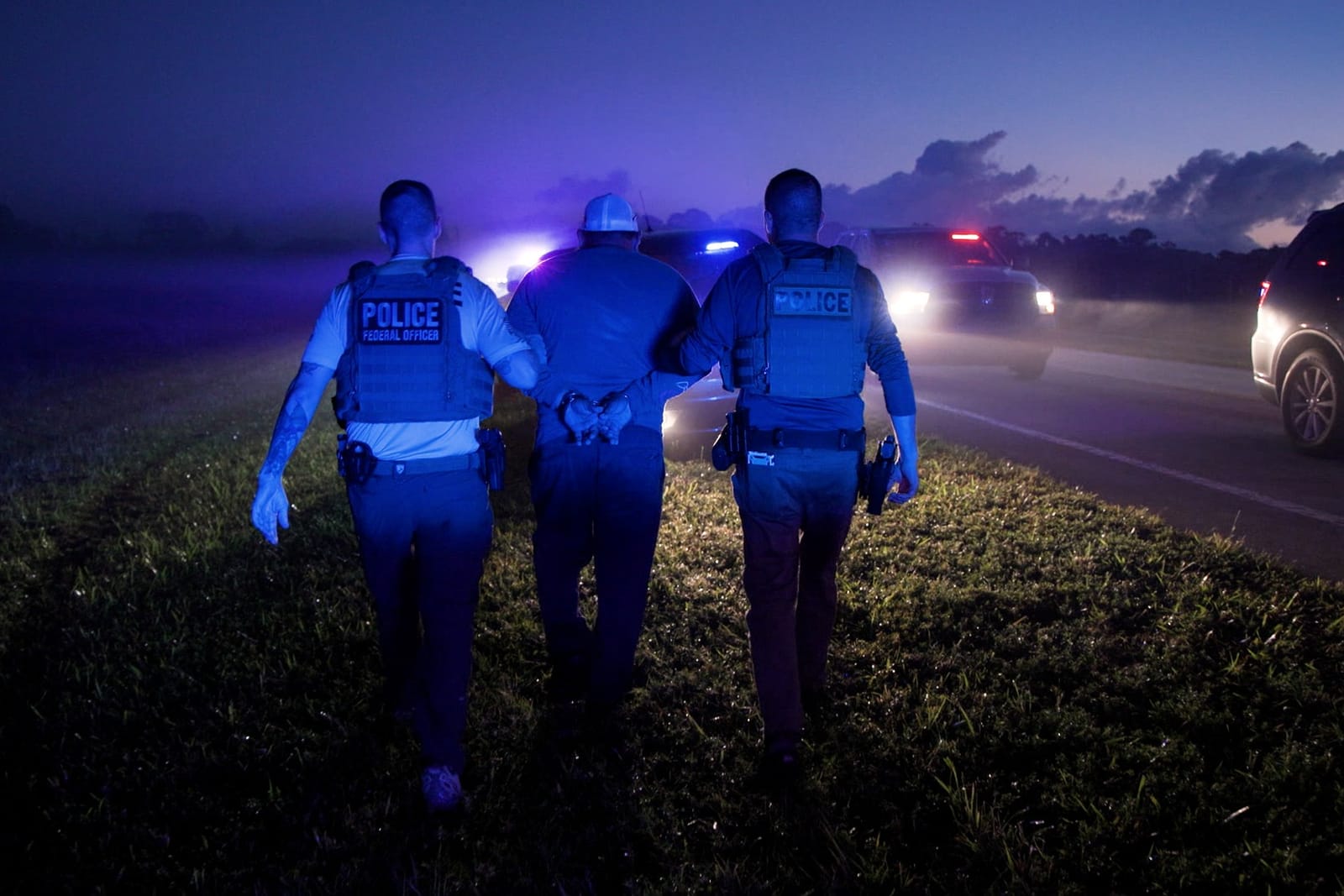
Immigration arrests hit a monthly high, most arrestees with no criminal conviction or charge. The Pentagon gutted the office meant to keep American bombs off civilians. The Environmental Protection Agency approved two chemicals it cannot say what dose kills.
Daily news review for Wednesday, August 26, 2026. Every source is footnoted. A note on method is at the bottom.
0% read, about 17 min remaining
Three separate arenas, one pattern: an arm of the state expanded what it can do to people, and the mechanism meant to constrain it was bypassed, defunded, or waived by the agency itself. None required new legislation; two required only a signature.
The counterweight is coming not from Washington but from county commission rooms in Ohio and Kansas, where data centers are the most concrete political fight of the midterms and the opposition has gone bipartisan in a way nobody priced in.
A Sanctuary Law Governs Officials. It Does Not Govern Data.
Aura Bogado, reporting for Injustice Watch with The Intercept2, documents how Illinois police and prosecutors evade the state's sanctuary law. The TRUST Act, passed in 2017, bars local police from assisting immigration agents or transferring people to ICE without a criminal warrant. Bogado found officials in more than a third of Illinois counties cooperating anyway, funneling at least 150 people into deportation; she discussed it on Democracy Now3.
In April 2025 an officer in Riverton pulled over Daniel Torrez Perez; a records check brought a direct call from an FBI agent. "I know you can't act on that," the agent said, "I know this puts you in a weird bind." The workaround: an arrest on an old driving-under-the-influence warrant, an overnight hold, and a transfer. Torrez was deported to Guatemala.
A sanctuary law governs what local officials may do, not what data does. Fingerprints from a local booking flow automatically to the FBI and the Department of Homeland Security, and departments say they cannot opt out.
404 Media4 reported yesterday that ICE, extending those pipes into election data, is seeking a contractor to deliver voter registration and history files from all 50 states, citing fraud detection, following its $125 million July plan with Thomson Reuters for names, addresses, and Social Security numbers. Researchers have found in-person voter fraud vanishingly rare.
Something crossed party lines on prosecution: the Cato Institute, the Foundation for Individual Rights and Expression, and the Society for the Rule of Law filed an amicus brief supporting left-wing protesters charged in the Minneapolis case, The Intercept5 reported, arguing the government used the domestic terrorism label to investigate disfavored groups. They cite National Security Presidential Memorandum 7, described in court filings as aimed at groups promoting what the memo calls anti-Americanism, anti-capitalism, and anti-Christianity. Prosecutors say the defendants blockaded facilities and surveilled agents; that is the government's characterization, and a judge has not ruled on it.
A correction on a recirculating story: Democracy Now interviewed6 Autumn Hill, a trans woman serving 50 years over the July 4, 2025 protest outside the Prairieland detention facility in Alvarado, Texas. The interview is new; the sentence is not. Those sentences came down in June: 30 to 70 years for most of the nine defendants, 100 years for a former Marine reservist prosecutors say shot a police officer, who says he acted in self-defense. The Justice Department calls the group an antifa cell; Hill says she had left before any shooting. Neither is a finding of fact.
The Data Center Is Now the Most Material Fight in American Politics
The Guardian reported this morning from Piketon, Ohio7, where OpenAI, Nvidia, and Japanese investors are putting $500 billion into one of the largest artificial intelligence data centers anywhere: 8 gigawatts on roughly 640 acres. SB Energy will own and operate it under a 20-year OpenAI lease, opening in 2028 alongside a natural gas plant funded through $33 billion of Japanese investment tied to last summer's tariff deal with Washington.
Pike County's poverty rate is over 19%, nearly double the national figure; median household income is $41,313. The project promises 35,000 construction jobs and 2,500 permanent ones. Part of the site sits on a decommissioned uranium enrichment plant that ran for nearly 60 years until 2001, blamed by residents for high cancer rates, including a 2019 middle school closure after high radiation readings. SB Energy says it did soil sampling and will pay for accelerated cleanup.
Earthjustice sued the EPA this morning over its approval of two new data center chemicals, reported by the Guardian8: photoacid generators used in chip manufacturing that appear to be forever chemicals, though the documentation, including the manufacturer's name, is largely redacted. The EPA identified acute and genetic toxicity, and reproductive and developmental effects, as public risks via drinking water, groundwater, and air releases, then wrote those risks "were not quantified due to insufficient information on hazard," that exposure could cause acute lethality it had insufficient data to assess, and that the substance likely presented an unreasonable risk it could not estimate. It approved both for immediate use anyway. The Toxic Substances Control Act requires the agency to prohibit or limit unreasonable-risk substances.
AP, Axios, NBC, and Brookings all document data centers reshaping midterm races in Michigan, Ohio, and Pennsylvania. In Emporia, Kansas, teacher Lux Claridge was arrested for clapping at a July data center meeting and held eight hours; the city dropped the charges yesterday9. Emporia had moved meetings to virtual only after the incident; in-person meetings resume today, and the city votes in November on banning hyperscale data centers outright.
Municipal Surveillance Is Generating Its Own Criminal Docket
In Oviedo, Florida, police 3D-printed a fake license plate reader camera10 as a decoy after real ones were stolen, then arrested Evan Meyer for cutting it down. He faces three felonies, including criminal mischief for property damage exceeding $1,000. The prop cost whatever the filament cost; a real camera runs about $800. The department cites an ongoing investigation to withhold decoy-design records, and says no emails, texts, or minutes exist.
In San Diego, event producer Anthony Ralphs, after a year of getting nowhere in a suit, showed up on August 19 in a Darth Vader costume11 with a voice changer to argue for the surveillance network from the Empire's side. The video went global; he later unmasked and asked the five council members who voted for the system when it ends.
A Trade War With No Constituency Anyone Has Been Able to Name
Canadian Finance Minister Francois-Philippe Champagne announced tariffs12 of 15% to 50% on roughly $27.6 billion of American goods, more than 700 products, effective September 8. It follows 50% American tariffs on about $20 billion of Canadian imports imposed Saturday; Trump says steel and auto tariffs hit 50% next year.
The United States imported $328 million of toilet paper from Canada13 in 2024, more than from anywhere else, and Canada is now threatening 25% to 50% tariffs on the tissue stock American manufacturers still buy. Republican Senator Susan Collins of Maine called the move a mistake. Trade Representative Jamieson Greer says this is 5% of imports from Canada and 0.06% of American consumption, with "no possible way" it can affect American well-being.
Vox's Zack Beauchamp, writing analysis rather than reporting14, argues the trade war has no constituency: no faction, no industry, no voting bloc. The United Auto Workers opposed the auto tariffs; populist tariff intellectuals call it madness. His read: not a strategy that went wrong but a personal fixation deputies are backfilling with policy. Take it as argument, but nobody has produced the policy paper or the industry backer.
Three Ledgers on the Iran War, and None of Them Agree
Treasury Secretary Scott Bessent announced Monday what he calls Operation Economic Outcast, a secondary sanctions campaign aimed at Iran's oil, shipping, and aviation sectors, and at third countries and firms still trading with Tehran. Treasury has mapped "every node, every facilitator, and every network" Iran uses to evade sanctions, he said, giving no start date and saying the delay gives everyone the opportunity to remedy bad behavior. Iran's rial has fallen to a record low of around 2 million to the dollar, down roughly 10% in two weeks.
Nicholas Mulder, the Cornell historian who wrote the standard history of sanctions, told Democracy Now15 the announcement is mostly psychological. His durable point: China buys over 80% of Iran's oil, and Chinese banks make up roughly half the world's ten biggest banks, so secondary sanctions against them mean aiming at the plumbing of global finance, probably ending the American trade truce with Beijing. That is argument, not forecast, but it identifies where the constraint sits. Iran's economy minister called the campaign economic terrorism, the Iranian government's claim.
The Pentagon's Defense Casualty Analysis System now lists 776 American service members killed or wounded since the war began February 28: 18 dead, 758 wounded. Roughly 60 were added in the last update, and about 345 of the total have come since a second ceasefire collapsed on July 7. Nick Turse at The Intercept16 reports two anonymous officials saying the department slow-walked the numbers after damaging Iranian strikes. Turse also documents a wounded count that read 500 on July 21 and now reads 431.
On the Iranian side, the World Health Organization estimates 37,181 total casualties and 3,375 deaths, while Iranian state media has reported roughly 3,500 killed: an international body's estimate and a government's claim, belonging in different columns.
On the cyber side, Reuters reports exclusively that a hack of a water sector supplier has drawn FBI scrutiny amid Iran-linked concerns. Drop Site News17 continues tracking the boat strikes and covered Iran sanctions in a livestream18 yesterday.
Every Combatant Commander Told Hegseth Not to Cut the Civilian Protection Program
The strongest reporting today is ProPublica's19: Megan Rose and Hannah Allam obtained the internal record of how the Civilian Harm Mitigation and Response program was gutted. Defense Secretary Pete Hegseth polled combatant commanders in early 2025 on three options: cut 65% of staff but keep it running, shrink it to a small Washington office, or eliminate it. Not one endorsed elimination; nine picked the least severe option. Central Command wrote that gutting the program would cause "decreased efficiency" of American lethal operations "due to an increased risk of target misidentification," and that the work had "enhanced our precision and accuracy, making us more lethal."
Hegseth cut it anyway. Roughly 200 staff down to about 24, some part-time. Central Command went from 16 people to one, after saying nine was its floor.
Airwars, a British monitoring group, counted 153 civilians killed and 243 wounded in the spring 2025 Yemen air campaign, which Hegseth publicly called a clear, limited mission executed with ruthlessness. Amnesty International has attributed to an American strike the attack on a girls' school in Minab, Iran that killed more than 100 children; the date is reported inconsistently between late February and late March, so it should be treated as unsettled while the toll and attribution stand as Amnesty and multiple news organizations established them. The Pentagon is now weighing an April rebuild to about 70 full-time staff; it did not respond to ProPublica.
ProPublica also published a takeaways companion20 to its investigation of an artillery plant outside Dallas. General Dynamics has been paid $533 million to build a factory for 155mm shells and has produced no usable shells. The Army awarded the contracts without competitive bidding in November 2022, under a wartime exemption Congress had granted, and approved three production lines without requiring proof a line could meet specifications. Twelve former workers describe robotic arms catching fire and machines mangling shell noses. The Army halted two of three lines in August 2025, did not terminate the contracts, issued $26.3 million in progress payments that December, and has not asked for any money back. The same General Dynamics unit has since received $2.5 billion in further awards.
The Autonomous Weapons Track Moved, and It Has a Deadline
The United Nations and the International Committee of the Red Cross issued a joint appeal21 Tuesday from Geneva for binding rules on autonomous weapons. Secretary-General Antonio Guterres and ICRC President Mirjana Spoljaric wrote that "we are now dangerously close to crossing a moral red line, the autonomous targeting of humans by machines." Their sharper point: the scientists and engineers building these systems have raised the alarm themselves, and when a technology's architects call for limits, states cannot afford to stay passive. Neither has confirmed a fully autonomous weapon's use in combat. Both point to a November Geneva conference under the Convention on Conventional Weapons as the clearest path to binding rules.
The Intercept ran a companion argument22 by Rebecca Gordon, a column rather than reporting, with nearly every fact sourced from other outlets. Its strongest point: when a swarm decides, responsibility scatters across a whole system, and existing humanitarian law has nobody to hold.
Also This Week
Synthetic think tanks as a distribution layer. 404 Media23 reported that the Hanover Institute for Public Policy, run by ad firm Piro, tied through foreign agent filings to Israel's official ad agency, has published more than 100 machine-written articles in under a month, per Pangram, built for chatbots to scrape. Its cofounder pitches the service as "artificial intelligence story optimization": propaganda as infrastructure, not content.
AI ownership rather than AI regulation. In Jacobin24, Peter Dorman argues AI firms should leave shareholder control but not go to the state, proposing legally binding purpose trusts on the Patagonia model. His objection to public ownership: it concentrates power in an already undemocratic state and presumes a single public interest. He concedes the model is largely untested.
The replacement is slower than the buildings. Reuters reports that Mark Zuckerberg's plan to replace Meta staff with AI agents fell apart internally; the company had explored cuts of up to 60% of some teams before pulling back. Set that against the $500 billion Ohio project: the buildings meant to house the replacement are going up faster than the replacement itself.
The election machinery stays unsettled. The Supreme Court on Monday lifted one of two injunctions blocking Trump's executive order on mail voting. Steve Vladeck of Georgetown Law made the narrow point on PBS NewsHour25: the Court did not rule on lawfulness, only that states sued too early. A second injunction still stands, blocking implementation. The March order directs the Postal Service to pick mail-ballot recipients and DHS to build an eligible-voter database; some states begin absentee voting September 18.
A Federal Reserve deadline today. Trump's renewed attempt to remove Fed Governor Lisa Cook reaches its deadline today, after a letter this month demanded she answer mortgage fraud allegations. Reuters found she disclosed the property to the lender as a vacation home. Vox's Ian Millhiser, arguing a case rather than reporting one26, blames the Court for an opinion too unclear to show what the president may do. Its actual holding was narrow: Cook was entitled to notice and a chance to respond before termination.
South Carolina. Senator Darline Graham won the Republican runoff for the seat once held by her brother Lindsey Graham, beating Representative Ralph Norman 52.4% to 47.6%. Trump recommended her appointment, and his political action committee spent more than $800,000. She faces Democrat Annie Andrews in November.
Fifteen children, five counties, ten years. ProPublica and the Oregonian investigated27 the Followers of Christ, a faith-healing sect in Idaho. Medical experts found at least 15 babies and children died of treatable illnesses between 2015 and 2025, among them two newborns in the same family, 13 months apart, both dead of pneumonia. Idaho has exempted faith-healing parents from child neglect charges28 since the 1970s. Oregon repealed its version nearly 30 years ago; prosecutors there report more parents have since sought care. ProPublica says its count is almost certainly low.
One in four, and that is the floor. A study of roughly 235 donated brains from former National Football League players who died between 2016 and 2021 found chronic traumatic encephalopathy in at least one in four29. Co-author Chris Nowinski calls that extremely conservative, since it's diagnosable only after death. The league says it has changed rules and helmets, and that the average death age, about 66, reflects an earlier era.
Afghanistan after the aid cuts. PBS NewsHour filed from rural Herat and Jalalabad30. Refugees International attributes more than 160 deaths in 18 months to American aid cuts. Nearly 500 clinics closed after last year's cuts and about 300 more this year, leaving roughly 6 million without local health care. At Nangarhar Government Hospital, its malnutrition ward reports nearly 20% of admitted babies now die. With women's education banned, no new midwives have graduated in five years.
Elsewhere. Hundreds are missing and at least eight dead after an avalanche triggered flash floods on the Nepal-China border, figures still moving. A fire in a hospital nursery in Islamabad killed 14 newborns. And Dolly Parton died Monday31 at 80; her representatives say the cause was cancer.
The Coverage Gap
Two directions, and the second is the uncomfortable one.
Start with what conservative outlets carried that left and independent outlets did not. The most useful convergence is invisible from the left feeds: Breitbart carried Senator Ted Cruz saying he dislikes license plate reader cameras and that police should not surveil innocent citizens, and Republican Representative Rich McCormick saying new data centers should not get any tax breaks. Left and independent outlets covered the data center backlash and the surveillance fight almost entirely as community and left-flank stories. The right-flank defection is real, on the record, and the thing that makes either fight winnable: a genuine hole.
The Dispatch ran a piece arguing the data center backlash is a new moral panic, and no left outlet engaged the counterargument today. It also ran an explainer on the country's $40 trillion in debt, and a report from inside Iran six months into the war, mattering more since left and independent outlets covered the sanctions regime in detail but the Iranian civilian experience barely at all. National Review ran two political economy pieces with no left equivalent, one on young men leaving the workforce and one arguing public pension trustees need statutory reminders about whose money they manage. Both are ideological, both about material conditions, both unanswered. National Review also ran an analysis of China pursuing what it calls unification without formal unification on Taiwan, more substantive Taiwan coverage than the left body produced today.
On tariffs, note the direction. National Review ran "The Pointless Trade War with Canada" and "One Dumb Tariff (Among Many)." The Dispatch ran "How Bad Could the U.S.-Canada Trade War Get?" and "Trump's Trade War With Canada Is Not About Canada." The right's serious outlets are converging with Vox's read, worth knowing before arguing it.
Amplification is different, not a hole. The dominant coordinated story on the right today is an attack on Democratic candidate Abdul El-Sayed over his refusal to condemn streamer Hasan Piker: Breitbart twice, the Daily Wire, National Review, and a Washington Examiner piece titled "every Democrat should have to answer for Hasan Piker." Jacobin covered it from the opposite side, arguing centrists despise Piker more than they want to win. Both bodies are engaged; the volume previews a general election line, not news. Breitbart also ran a triumphal Iran frame: Trump cleared the mines in the Strait of Hormuz and broke Iran's grip, a claim from the administration's allies that sits awkwardly against the Pentagon's own casualty ledger and the naval blockade still in effect. Fox led with a running tally of the boat strikes at 227 killed in 68 strikes; Drop Site independently counts at least 223 since September 2025. Two tallies from opposite directions landing in the same place is about as close to confirmation as an uncounted campaign gets; credit to Fox for publishing a number at all.
Now the other direction: left and independent outlets broke real accountability journalism today that conservative outlets ignored completely. ProPublica's documentation that every combatant commander told Hegseth not to gut the civilian protection program, and that he did it anyway, is a story about military effectiveness in the Pentagon's own words; it should be a fiscal and operational conservative story. Nothing on the right touched it. The same goes for $533 million spent on an artillery plant that has produced nothing, with no repayment demanded and $2.5 billion in follow-on awards to the same contractor: a procurement scandal tailor-made for a small-government outlet. Silence.
Also carried on one side only: the Illinois sanctuary law investigation, the EPA lawsuit over chemicals the agency admits it cannot evaluate, the Idaho faith healing deaths, the Pentagon's own casualty count in Iran, the collapse of Afghan health care after the aid cuts, and the Reuters exclusive on the water sector hack, arguably the most consequential domestic security story of the day, appearing nowhere on the right feeds despite being about Iran.
One asymmetry worth naming rather than filing. The right's serious outlets spent today on debt, labor force participation, pensions, Taiwan, and tariffs. Left and independent outlets spent it on enforcement, civilian harm, and corporate power. Both lists are incomplete in ways the other would fix, and the overlap is almost entirely tariffs, the one issue everybody here argues the same way. A structural habit runs underneath both sides: volume gets mistaken for coverage, and the war with Iran keeps getting covered as a war and almost never as a price, whether that price is a rial at 2 million to the dollar, a water utility breach in a state nobody names, or a school in Minab.
Method
Built from the daily briefing pipeline run of August 26, 2026, covering the preceding 24 hours.
Feeds and window. 23 of 24 RSS feeds resolved; the NPR feed failed with malformed XML and needs re-pointing. 153 body items and 85 detection items were staged headline-only; 30 spine and key-analysis articles were read in full.
Source weighting. Reuters and the Associated Press arrive as Google News bridges, and The Atlantic and Wired are paywalled, so all four are treated as headline-and-summary only, named in plain text, not linked. The Guardian's deportations article returned an HTTP 403; its data came from the Guardian's own live blog. Detection feeds are split by trust class: National Review and The Dispatch as gap-signal; Fox News, the New York Post, the Daily Wire, Breitbart, and the Washington Examiner as narrative.
Live fact-check. Roughly 45 factual claims were checked against live web search, including the July ICE arrest total, the Canadian retaliation value, the Pentagon casualty ledger, the boat-strike tallies, the CTE study, and Dolly Parton's cause of death.
Attribution discipline. Government claims about casualties, damage, or fraud are attributed to the government that made them, one standard regardless of government. The Pentagon's ledger, Iranian state media's toll, the World Health Organization's estimate, and the Justice Department's characterization of defendants are each labeled as what they are. Opinion columns and analysis pieces are labeled as argument, never presented as reported fact.
Corrections in this edition. Nine corrections were made: six mechanical and three judgment calls. The judgment calls were the Prairieland sentences, handed down in June rather than this week; the Minab school strike, whose date is reported inconsistently across outlets and is therefore left unsettled while the toll and American attribution are given as Amnesty International established them; and the boat-strike death tally, given as a convergence of two independent counts rather than a single figure, because the Pentagon publishes no running total. One invented figure was caught and removed before publication.
Footnotes
31 footnotes, 31 unclassified.
A footnote carrying a classification was authored as a source record. The rest are the edition's own citations as published: outlet and address as they stood, with no classification, attribution posture or reading depth on record.
- 1
The Guardian (opens in a new tab)theguardian.com
The figures come from the Deportation Data Project, analyzed independently by the Associated Press and the Guardian.
- 2
The Intercept (opens in a new tab)theintercept.com
Aura Bogado, reporting for Injustice Watch with The Intercept, documents how Illinois police and prosecutors evade the state's sanctuary law.
- 3
Democracy Now! (opens in a new tab)democracynow.org
Bogado found officials in more than a third of Illinois counties cooperating anyway, funneling at least 150 people into deportation; she discussed it on Democracy Now.
- 4
404 Media (opens in a new tab)404media.co
404 Media reported yesterday that ICE, extending those pipes into election data, is seeking a contractor to deliver voter registration and history files from all 50 states, citing…
- 5
The Intercept (opens in a new tab)theintercept.com
Something crossed party lines on prosecution: the Cato Institute, the Foundation for Individual Rights and Expression, and the Society for the Rule of Law filed an amicus brief…
- 6
Democracy Now! (opens in a new tab)democracynow.org
A correction on a recirculating story: Democracy Now interviewed Autumn Hill, a trans woman serving 50 years over the July 4, 2025 protest outside the Prairieland detention…
- 7
The Guardian (opens in a new tab)theguardian.com
The Guardian reported this morning from Piketon, Ohio, where OpenAI, Nvidia, and Japanese investors are putting $500 billion into one of the largest artificial intelligence data…
- 8
The Guardian (opens in a new tab)theguardian.com
Earthjustice sued the EPA this morning over its approval of two new data center chemicals, reported by the Guardian: photoacid generators used in chip manufacturing that appear to…
- 9
404 Media (opens in a new tab)404media.co
dropped the charges yesterday
- 10
404 Media (opens in a new tab)404media.co
3D-printed a fake license plate reader camera
- 11
404 Media (opens in a new tab)404media.co
showed up on August 19 in a Darth Vader costume
- 12
PBS NewsHour (opens in a new tab)pbs.org
Canadian Finance Minister Francois-Philippe Champagne announced tariffs of 15% to 50% on roughly $27.6 billion of American goods, more than 700 products, effective September 8.
- 13
The Guardian (opens in a new tab)theguardian.com
toilet paper from Canada
- 14
Vox (opens in a new tab)vox.com
analysis rather than reporting
- 15
Democracy Now! (opens in a new tab)democracynow.org
Nicholas Mulder, the Cornell historian who wrote the standard history of sanctions, told Democracy Now the announcement is mostly psychological.
- 16
The Intercept (opens in a new tab)theintercept.com
Nick Turse at The Intercept reports two anonymous officials saying the department slow-walked the numbers after damaging Iranian strikes.
- 17
Drop Site News (opens in a new tab)dropsitenews.com
Drop Site News continues tracking the boat strikes and covered Iran sanctions in a livestream yesterday.
- 18
Drop Site News (opens in a new tab)dropsitenews.com
Drop Site News continues tracking the boat strikes and covered Iran sanctions in a livestream yesterday.
- 19
ProPublica (opens in a new tab)propublica.org
The strongest reporting today is ProPublica's: Megan Rose and Hannah Allam obtained the internal record of how the Civilian Harm Mitigation and Response program was gutted.
- 20
ProPublica (opens in a new tab)propublica.org
ProPublica also published a takeaways companion to its investigation of an artillery plant outside Dallas.
- 21
PBS NewsHour (opens in a new tab)pbs.org
The United Nations and the International Committee of the Red Cross issued a joint appeal Tuesday from Geneva for binding rules on autonomous weapons.
- 22
The Intercept (opens in a new tab)theintercept.com
The Intercept ran a companion argument by Rebecca Gordon, a column rather than reporting, with nearly every fact sourced from other outlets.
- 23
404 Media (opens in a new tab)404media.co
Synthetic think tanks as a distribution layer. 404 Media reported that the Hanover Institute for Public Policy, run by ad firm Piro, tied through foreign agent filings to Israel's…
- 24
Jacobin (opens in a new tab)jacobin.com
In Jacobin, Peter Dorman argues AI firms should leave shareholder control but not go to the state, proposing legally binding purpose trusts on the Patagonia model.
- 25
PBS NewsHour (opens in a new tab)pbs.org
Steve Vladeck of Georgetown Law made the narrow point on PBS NewsHour: the Court did not rule on lawfulness, only that states sued too early.
- 26
Vox (opens in a new tab)vox.com
arguing a case rather than reporting one
- 27
ProPublica (opens in a new tab)propublica.org
ProPublica and the Oregonian investigated the Followers of Christ, a faith-healing sect in Idaho.
- 28
ProPublica (opens in a new tab)propublica.org
exempted faith-healing parents from child neglect charges
- 29
PBS NewsHour (opens in a new tab)pbs.org
A study of roughly 235 donated brains from former National Football League players who died between 2016 and 2021 found chronic traumatic encephalopathy in at least one in four.
- 30
PBS NewsHour (opens in a new tab)pbs.org
PBS NewsHour filed from rural Herat and Jalalabad.
- 31
NPR (opens in a new tab)npr.org
And Dolly Parton died Monday at 80; her representatives say the cause was cancer.