In the thread The 2007 Non-Prosecution Agreement
The Immunity Shield
A federal immunity deal signed in 2007 and binding by January 2008 went unfiled and unreviewed by any court for 12 years. The identified victims were not told. A clause inside it extended federal immunity to named and unnamed co-conspirators in a category prosecutors never closed.
- Documents
- 9
- documents
- Citations
- 31
- citations
- People
- 7
- people
- Pages of record
- 2,065
- pages of record
- Reading time
- 14
- minutes to read
- Source discipline
24 primary, 3 corroborating, 4 tertiary. 31 citations in all.
- T1 Primary
- T2 Corroborating
- T3 Tertiary
- Anchor documents
- EFTA00800253, 14 pages. Also on Epstein Exposed, EFTA00800253, an alternative host for the same document.
- EFTA00027666, 33 pages. Also on Epstein Exposed, EFTA00027666, an alternative host for the same document.
- EFTA00192983, 85 pages. Also on Epstein Exposed, EFTA00192983, an alternative host for the same document.
- EFTA00073493, 44 pages. Also on Epstein Exposed, EFTA00073493, an alternative host for the same document.
- EFTA00184224, 982 pages. Also on Epstein Exposed, EFTA00184224, an alternative host for the same document.
- EFTA00224636, 92 pages. Also on Epstein Exposed, EFTA00224636, an alternative host for the same document.
- EFTA00225102, 276 pages. Also on Epstein Exposed, EFTA00225102, an alternative host for the same document.
- EFTA00230208, 229 pages. Also on Epstein Exposed, EFTA00230208, an alternative host for the same document.
- EFTA00185206, 310 pages. Also on Epstein Exposed, EFTA00185206, an alternative host for the same document.
- People in this piece
- Jeffrey Edward Epstein, Principal, Deceased
- Alexander Acosta, Prosecution
- A. Marie Villafana, Prosecution
- Sarah Kellen, Enabler, Immunity recipient
- Nadia Marcinkova, Enabler, Immunity recipient
- Lesley Groff, Enabler, Immunity recipient
- Adriana Ross, Enabler, Immunity recipient
- Reading key
- Miami HeraldSource 14reportingSarah KellenResearch Vault referenceEditorial essayargumentargument or opinion
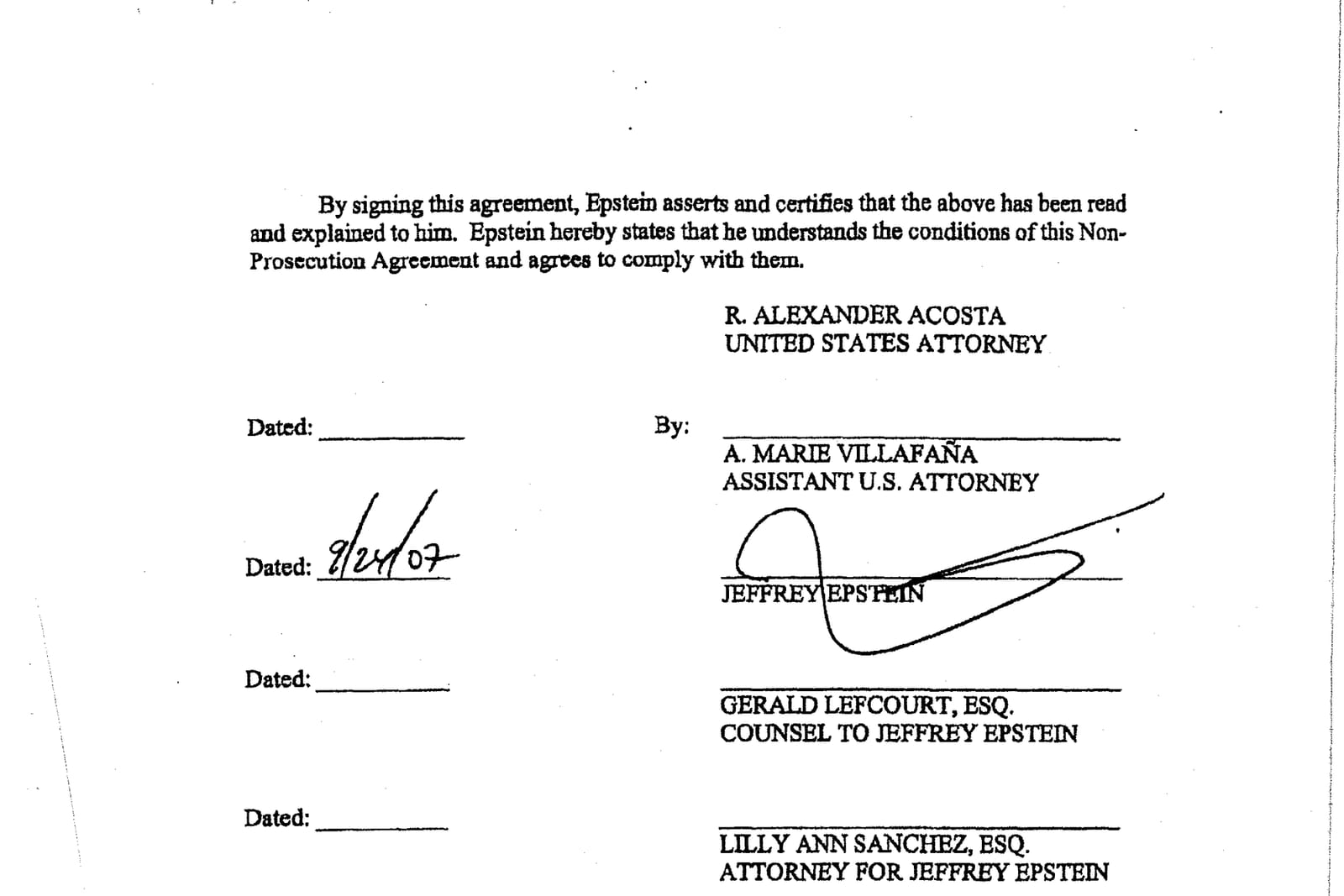
On September 24, 2007, the United States Attorney for the Southern District of Florida signed a federal non-prosecution agreement with Jeffrey Epstein. The document never went to a grand jury, and it was never filed in federal court. The identified victims, some of whom were still girls at the time of the conduct at issue, would not learn the agreement existed until well after it had taken effect. Buried near the end of its text was a clause that extended federal immunity not only to Epstein himself, but to named and unnamed potential co-conspirators, a category the prosecutors never publicly closed.
It would be 12 years before a federal judge examined what had been signed. When Judge Kenneth Marra ruled, in February 2019, that the government had violated the Crime Victims' Rights Act in negotiating and concealing the deal EFTA00800253EE, EFTA00800253 on Epstein Exposed, an alternative host for the same document, Epstein was still alive and under no federal charge. Within months he would be arrested in New York; within weeks of that arrest, he would be dead in federal custody. The statute of limitations on most of the conduct the agreement shielded had already run. What follows is a reconstruction drawn from the record.
What the Agreement Did
Under the NPA, Epstein pleaded guilty to 2 Florida state charges (solicitation of prostitution and procurement of a minor for prostitution) and served 13 months of an 18-month sentence under a work-release arrangement that permitted him to leave the Palm Beach County Stockade 6 days a week, returning only to sleep EFTA00185206EE, EFTA00185206 on Epstein Exposed, an alternative host for the same document. In exchange, the federal government agreed not to prosecute him for any federal offense arising from the conduct described in the government's proffered facts.
The immunity did not stop at Epstein. The agreement extended the same protection to 4 named individuals: Sarah Kellen, Nadia Marcinkova, Lesley Groff, and Adriana Ross EFTA00192983EE, EFTA00192983 on Epstein Exposed, an alternative host for the same document. Each of the 4 was identified in the government's own proffered facts as an employee or associate who had participated in the conduct prosecutors were now declining to pursue. None of them was charged, and none was required to testify. Nothing in the record indicates that any of them was later interviewed as a cooperating witness in a subsequent federal action.
Even the 4 names were not where the agreement's reach ended. Further into the same clause, immunity extended to "any potential co-conspirators" of Epstein, and the category was left open. No enumeration followed it. No outer boundary was specified. That open-ended phrasing is the part of the document that has mattered most, and it is the clause around which every subsequent question about who the agreement actually covered has been fought.
The Parallel Case That Was Abandoned
The agreement replaced a federal prosecution that was nearly ready to go. By the spring of 2007, the federal team working the case in West Palm Beach had assembled what court filings in the later CVRA action would describe as an 82-page prosecution memorandum and a 53-page draft indictment, with 32 criminal counts in total EFTA00800253, p3EE, EFTA00800253 on Epstein Exposed, an alternative host for the same document. The indictment named Epstein, 3 unnamed employees or assistants, and 2 of his corporate entities (JEGE Inc. and Hyperion Air Inc.).
It was never presented to a grand jury. By September, the U.S. Attorney's office in the Southern District of Florida was circulating drafts of the non-prosecution agreement instead. Internal correspondence between Assistant U.S. Attorney A. Marie Villafana, the lead prosecutor in West Palm Beach, and Jay Lefkowitz of Kirkland & Ellis, Epstein's lead negotiator, runs continuously through the fall of 2007 and into the winter of 2008 EFTA00225920EE, EFTA00225920 on Epstein Exposed, an alternative host for the same document. By late January 2008, the agreement was binding on the United States.
The prosecution memo, the draft indictment, and the full text of those 2007 negotiations remain only partially visible in the current EFTA production. Locating the 82-page memo and the 53-page indictment is an open item in this investigation.
The Four Named Recipients
Sarah Kellen was Epstein's executive assistant. What that title meant, as documented both in the NPA's proffered facts and in the civil depositions that came later, was that she did the scheduling. She booked the appointments at which the abuse the federal government later declined to prosecute occurred. In the indexed email corpus she is almost invisible under her own name, but the shared phone line at 917-855-3363 appears in Epstein's address book as a joint Epstein/Kellen number, and the lines she managed run throughout the scheduling traffic that is there.
Nadia Marcinkova is described in victim testimony, later incorporated into the CVRA record, as a direct participant in the sexual abuse of identified minors EFTA00073493EE, EFTA00073493 on Epstein Exposed, an alternative host for the same document. She was 18 years old when Epstein first brought her into the United States. By the time of the events described in the government's proffered facts, victim testimony places her inside the conduct the NPA declined to prosecute, not beside it.
Lesley Groff ran logistics and scheduling out of Epstein's New York office, and her name appears on virtually every thread in the indexed scheduling corpus. The volume tracks the administrative demands of the role, not any case-relevant frequency. In the knowledge graph she is carried as person_type: enabler, legal_status: no_action. The second field is not a finding about her conduct. It is the downstream effect of the agreement.
Adriana Ross appears in the same proffered facts, placed there as having been present during the conduct the NPA forecloses. Of the 4, she is the least-documented in the current corpus, and that is itself a fact worth noting.
Each of the 4 carries the same combination in the knowledge graph: identified participation in documented conduct, followed by no federal action. The NPA is what produced that pattern. It is what the agreement, by design, was built to do.
The Concealment
On February 21, 2019, Judge Kenneth Marra of the Southern District of Florida issued the first judicial review of the NPA by a court with the authority to scrutinize it EFTA00800253EE, EFTA00800253 on Epstein Exposed, an alternative host for the same document. His order held that the federal government had violated 18 U.S.C. § 3771, the Crime Victims' Rights Act, by negotiating and finalizing the agreement without notifying the identified victims or giving them a meaningful opportunity to confer.
The concealment had specific moving parts. The agreement was not filed with the court. In January 2008, weeks after the NPA had already become binding, the government mailed the identified victims what Marra would later characterize as "misleading" letters: communications that represented the federal investigation as ongoing and asked the women and girls for patience EFTA00027666EE, EFTA00027666 on Epstein Exposed, an alternative host for the same document. The letters did not mention that a federal immunity agreement had been signed the previous September. They did not mention that the investigation, as a federal matter, was already over.
When the government came to defend the secrecy in front of Marra, it argued that formal notification would have jeopardized the plea. Marra rejected the argument on the plain language of the statute. The CVRA grants conferral rights, not veto rights, and Congress did not write an exception for cases the government judges to be sensitive EFTA00800253EE, EFTA00800253 on Epstein Exposed, an alternative host for the same document.
The Defense Team
For a defendant eventually pleading to state-level prostitution charges, Epstein's defense team on the NPA was extraordinary. Correspondence indexed in this investigation identifies at least 7 attorneys who participated in the NPA negotiations EFTA00224636EE, EFTA00224636 on Epstein Exposed, an alternative host for the same document: Jay Lefkowitz of Kirkland & Ellis, who ran the negotiation; Roy Black in Miami; Martin Weinberg in Boston; Jack Goldberger in West Palm Beach; Gerald Lefcourt in New York; Guy Lewis, himself a former U.S. Attorney in the same district; and Alan Dershowitz.
The composition of the team is itself evidence. A former U.S. Attorney in the same district, national-firm white-collar counsel, a prominent legal academic, and regional criminal defense specialists together do not read like a roster built to try a case. They read like a roster built to apply pressure through peer channels. Marra's 2019 opinion records one use of those channels: when negotiations stalled in January 2008, Epstein's attorneys appealed the local prosecutors' position upward, to "higher levels within the Department of Justice" EFTA00800253EE, EFTA00800253 on Epstein Exposed, an alternative host for the same document. Who those officials were is not established in the current record, and it is among the questions this investigation has not yet answered.
The Role Switch
During the period the Epstein investigation was active, Bruce Reinhart was an Assistant U.S. Attorney in the Southern District of Florida. After he left the office, he appeared as counsel of record for Epstein's employees, including the 4 named NPA beneficiaries, in the CVRA proceedings before Marra EFTA00081116EE, EFTA00081116 on Epstein Exposed, an alternative host for the same document. He was later appointed a federal magistrate judge in the same district he had once prosecuted out of.
The CVRA record establishes the role switch as fact. The timeline around it is another matter. When Reinhart left the U.S. Attorney's Office, what Epstein-related information he carried out with him, and what the engagement in the CVRA action was built on, are questions the current production does not resolve. They are the kind of questions an investigator ordinarily wants answered before they are allowed to fade.
What the 2019 SDNY Memo Suggests
In December 2019, 4 months after Epstein's death in a Manhattan cell, the Southern District of New York produced an 86-page memorandum titled Investigation into Potential Co-Conspirators of Jeffrey Epstein, addressed to then-U.S. Attorney Geoffrey Berman. The memo identifies 8 suspected co-conspirators. Of those 8, 4 overlap with the recipients named in the NPA, and 4 do not.
The SDNY memorandum itself has not yet surfaced in the EFTA production, and locating it is a recurring open item. The shape of it matters even before the document is located. When SDNY reopened the threads that SDFL had closed, its prosecutors assembled a list of potential federal defendants at least twice the size of the 4 names in the NPA. The gap between SDFL's 4 and SDNY's 8 is the question this investigation is built around.
What This Article Does Not Claim
This article does not claim that the NPA was corruptly negotiated. It does not claim, of any particular individual, that they committed a federal offense from which the agreement shielded them. It does not identify by name the "higher levels within the Department of Justice" that Marra's opinion references. Those are questions the current evidentiary record cannot answer, and the record does not license speculation in place of answers.
What the record does support, in primary-source material, is this. A federal immunity agreement was signed. It named 4 individual recipients and extended to additional, unnamed "potential co-conspirators" in a category prosecutors never closed. It was concealed from the identified victims until after it was already binding. A fully prepared federal prosecution was abandoned in favor of it. A federal judge, 12 years later, ruled that the concealment violated the Crime Victims' Rights Act. And the complete set of individuals the agreement shielded has never been publicly enumerated by the government that signed it.
Open Items
Several items remain open, and any one of them, if located, would substantively change the analysis: the 82-page prosecution memorandum; the 53-page draft indictment; the December 2019 SDNY memo; the January 2008 victim-notification letters; the February 1, 2007 defense team letter (24 pages); the Reinhart timeline; the identity of the DOJ officials contacted by the defense in January 2008; and the scope of the "potential co-conspirators" category as understood by the signatories in 2007.
Each of those items is fair game for this corpus or the next production to surface.
Documented network
Network as structured text
Subject
- Jeffrey Epstein: Subject of the NPA. Charged under Florida state law; served 13 months with work release. Died in federal custody August 2019.
Prosecution
- Alexander Acosta: U.S. Attorney, Southern District of Florida. Approved the NPA. Resigned as U.S. Secretary of Labor July 2019.
- A. Marie Villafana: Lead AUSA, West Palm Beach. Drafted the NPA and corresponded directly with defense counsel.
- Lilly Ann Sanchez: AUSA, SDFL. Signatory on NPA-related correspondence.
- Dexter Lee: AUSA, U.S. Attorney's Office, Miami.
Defense Team
- Jay Lefkowitz: Lead NPA negotiator; Kirkland & Ellis LLP. Principal correspondent with Acosta and Villafana.
- Roy Black: Criminal defense attorney. Black Srebnick Kornspan & Stumpf, Miami. Intervenor in CVRA proceedings on behalf of Epstein employees.
- Alan Dershowitz: Defense team member. Intervenor in CVRA proceedings.
- Martin Weinberg: Defense attorney, Boston.
- Jack Goldberger: Defense attorney; Gold & Associates, West Palm Beach.
- Gerald Lefcourt: Defense attorney, New York.
- Guy Lewis: Former U.S. Attorney; joined Epstein defense team.
Immunity Recipients
- Sarah Kellen: Epstein's executive assistant; scheduled victims' appointments. Named immunity recipient under NPA. No federal action taken.
- Nadia Marcinkova: Epstein associate; documented participation in abuse of identified victims. Named immunity recipient under NPA. No federal action taken.
- Lesley Groff: Epstein's executive assistant; managed logistics and scheduling. Named immunity recipient under NPA. No federal action taken.
- Adriana Ross: Epstein associate; present during documented abuse. Named immunity recipient under NPA. No federal action taken.
- Ghislaine Maxwell: Not explicitly named in the NPA text. Convicted by SDNY in 2021 on sex trafficking charges. The extent to which NPA immunity was interpreted to cover her remains unresolved.
Judicial
- Kenneth Marra: U.S. District Judge, SDFL. Feb. 21, 2019 ruling that the government violated the Crime Victims' Rights Act in negotiating and concealing the NPA.
- Bruce Reinhart: Former AUSA, SDFL. Appeared as intervenor for Epstein employees in CVRA proceedings after leaving the U.S. Attorney's Office. Later appointed federal magistrate judge.
Victims' Counsel
- Bradley Edwards: Lead attorney for Jane Doe 1 and Jane Doe 2 in the CVRA action.
- Paul Cassell: Victims' attorney; law professor; pro hac vice.
Tier-labeled relationships
- Tier 1: Alexander Acosta to Jeffrey Epstein. approved NPA Source: EFTA00192983.
- Tier 1: A. Marie Villafana to Jeffrey Epstein. negotiated NPA Source: EFTA00225102.
- Tier 1: A. Marie Villafana to Jay Lefkowitz. primary correspondent Source: EFTA00225920.
- Tier 1: Jay Lefkowitz to Jeffrey Epstein. lead counsel Source: EFTA01718506.
- Tier 1: Roy Black to Jeffrey Epstein. counsel Source: EFTA00188608.
- Tier 1: Roy Black to Sarah Kellen. intervenor counsel (CVRA) Source: EFTA00205293.
- Tier 1: Bruce Reinhart to Sarah Kellen. intervenor counsel (CVRA) Source: EFTA00081116.
- Tier 1: Alan Dershowitz to Jeffrey Epstein. defense team Source: EFTA00230208.
- Tier 1: Martin Weinberg to Jeffrey Epstein. defense team Source: EFTA00224636.
- Tier 1: Jack Goldberger to Jeffrey Epstein. defense team Source: EFTA00224636.
- Tier 1: Gerald Lefcourt to Jeffrey Epstein. defense team Source: EFTA00224636.
- Tier 1: Guy Lewis to Jeffrey Epstein. defense team Source: EFTA00224943.
- Tier 1: Jeffrey Epstein to Sarah Kellen. employed; named immunity recipient Source: EFTA00192983.
- Tier 1: Jeffrey Epstein to Nadia Marcinkova. associate; named immunity recipient Source: EFTA00073493.
- Tier 1: Jeffrey Epstein to Lesley Groff. employed; named immunity recipient Source: EFTA00073493.
- Tier 1: Jeffrey Epstein to Adriana Ross. associate; named immunity recipient Source: EFTA00073493.
- Tier 3: Jeffrey Epstein to Ghislaine Maxwell. co-principal (scope of NPA coverage disputed) Source: EFTA00205254.
- Tier 1: Kenneth Marra to Alexander Acosta. ruled NPA violated CVRA (2019) Source: EFTA00800253.
- Tier 1: Kenneth Marra to A. Marie Villafana. ruled NPA violated CVRA (2019) Source: EFTA00027666.
- Tier 1: Bradley Edwards to Kenneth Marra. petitioner Source: EFTA00191264.
- Tier 1: Paul Cassell to Kenneth Marra. petitioner (pro hac vice) Source: EFTA00191264.
- Tier 1: Lilly Ann Sanchez to A. Marie Villafana. co-counsel Source: EFTA00192625.
- Tier 1: Dexter Lee to A. Marie Villafana. co-counsel Source: EFTA00192625.