Commentary
The Records We Gave Them Have a Second Job
Tax returns, license plates and the people in our phones were collected for one purpose each. This week showed each of them being put to work sorting people, while the government's records about itself kept disappearing.
A Question on the Tax Form
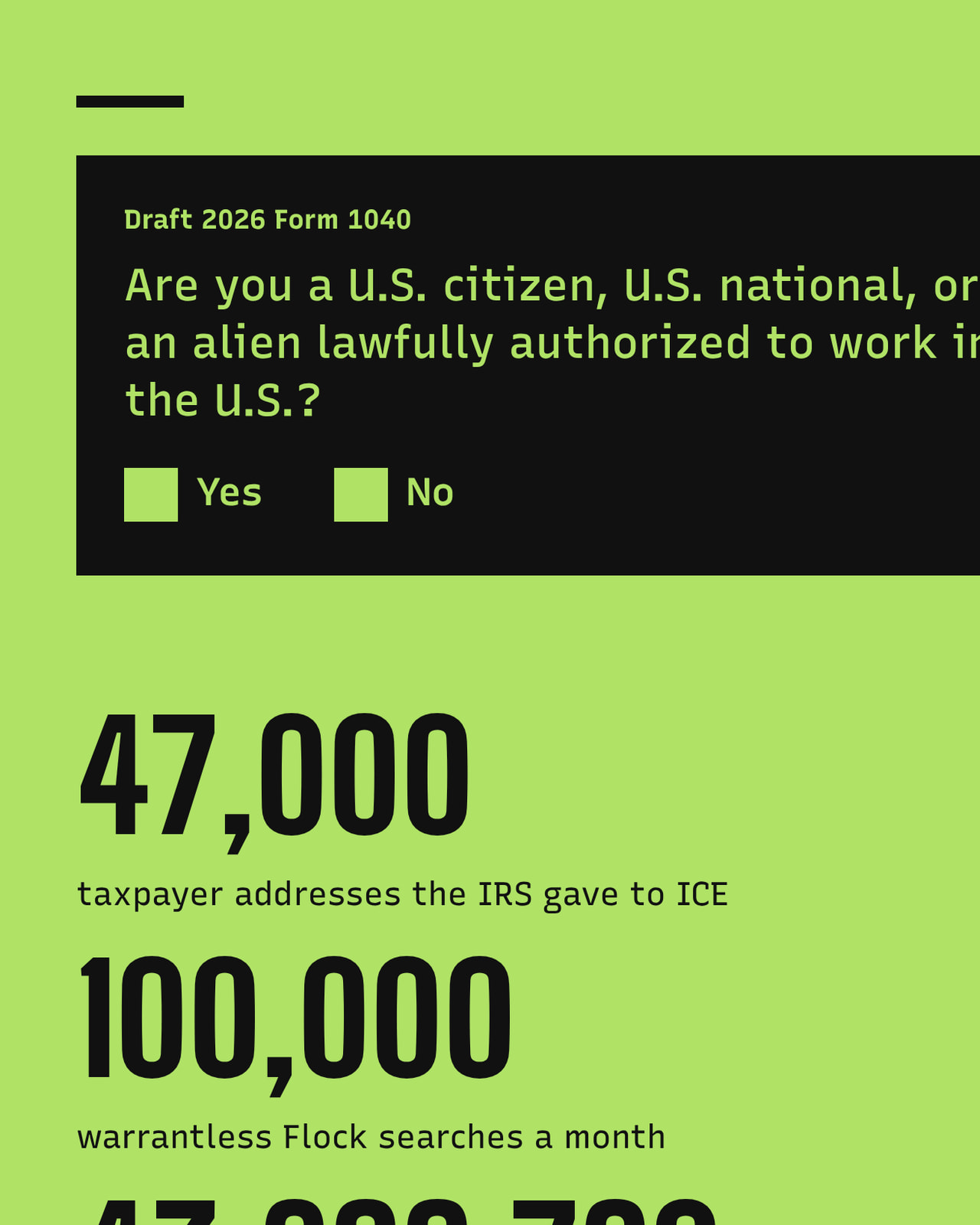
The draft 2026 Form 1040 asks something no federal tax return has asked before: whether the filer is "a U.S. citizen, U.S. national, or an alien lawfully authorized to work in the U.S."1 The administration says the question could save taxpayers up to $2 billion by stopping benefits from reaching people who are not eligible for them.1 That is its own estimate. Nina Olson of the Center for Taxpayer Rights answered that the IRS already holds the Social Security and taxpayer identification data it needs to process a return, and that the question drags the agency into immigration policy.1
If she is right, this is not a tax measure that happens to touch immigration. It is an immigration measure printed on a tax form. That distinction is the subject of this piece, because the 1040 was not the only record this week that turned out to have a second job.
My argument is that the records people hand over for one purpose are being converted into the means of sorting them, and that the line between the public and private versions of that conversion has become a matter of who buys what from whom. The government's records about us are growing. Its records about itself are shrinking. That asymmetry is the week's real story.
The Public Ledger
The tax data already has a history. Before a federal judge halted the arrangement for violating taxpayer privacy law, the IRS had given Immigration and Customs Enforcement the addresses of 47,000 people.1 Michael Lewis's new book, excerpted in the Guardian, puts a person at the center of that story: an IRS privacy chief who refused a Homeland Security request for 700,000 addresses and resigned weeks short of a 20-year pension.2 That account comes from a book and is contested. The former acting commissioner, Melanie Krause, denies agreeing to release the data.2 The disclosure itself is not in dispute.
License plates are going the same way, through older plumbing. 404 Media documented how the High Intensity Drug Trafficking Areas program, a grant structure built in the 1980s for drug enforcement, now pulls local plate-reader data into federal centers. There are 33 such programs covering all 50 states, and the administration gave the program another $277 million in July.3 Asked for its own plate data, the Randolph County Sheriff's Office in North Carolina said that "all data is kept on the Federal Houston-HIDTA database" and could not be shared with the public.3
That sentence is the mechanism in miniature. Local consent rules govern the camera on the corner. They do not reach the data once it has moved somewhere those rules do not apply.
Files on the People Who Watch
The records are not only about migrants. Unsealed filings in a proposed class action in Maine, reported by WIRED, allege that ICE has been building files on people who film its arrests and storing them in the case management system Palantir built for the agency.4 According to the filings, one agent labeled two people filmed in a parking lot a threat to law enforcement and a professional protester, then circulated their photographs for a facial recognition search. Homeland Security calls the case meritless, while its own motion to dismiss concedes the records were created and argues the agent acted against policy. Both observers have stopped watching ICE operations entirely.4
A federal judge in Oklahoma put a name to the scale. Judge Sara Hill ruled that a Tulsa County deputy violated the Fourth Amendment when he ran a woman's plate through Flock's camera network only because it was from California, pulling "more than 50 individual records" of where she had been across the country in a month. "This is a type of indiscriminate mass surveillance," Hill wrote, and she threw out everything the search produced. By 404 Media's reading of audit logs, the network runs more than 100,000 warrantless searches a month.5
Now look at the records that run the other way. On 25 September ICE posted eight internal reviews of 2025 deaths in its custody, which documented mismanaged medication, skipped examinations and delayed emergency care. About four days later, after a lawyer for an Intercept reporter noticed them, the agency appeared to take them offline.6 The Pentagon's casualty database for the Iran war gained 37 names in September without an announcement, and a National Guard major who died in Kuwait in March is still missing from its list of the dead.7 The government's files on the people who watch it accumulate. Its files on what it does are revised quietly, or pulled.
The Stack Above the Camera
The private side of this is not separate. It is the same infrastructure with a different owner. Flock's chief executive says the company will not add facial recognition to its devices. A company called VIDIZMO has marketed face matching on Flock footage to police, with search filters for age, gender and race, though its chief executive says it has not yet built the integration. The privacy researcher Chris Gilliard made the structural point: Flock built infrastructure that other companies can layer more invasive tools on top of, so a limit on one system is not a limit.8 A promise made by the company that collects the data does not bind the company that buys it.
Meta's new assistant shows where the consumer version is heading. Instructions an independent researcher extracted from Muse, reported by WIRED, describe an hourly process that builds "a page for every person in the user's life," compiling data on family, partners, friends and colleagues.9 The people on those pages are not Meta's users. They are their users' families and friends, and none of them agreed to anything.
There was one serious counterweight, and it came from a state. On 25 September a Santa Fe jury found Meta liable for 43,899,720 violations of New Mexico's Unfair Practices Act, including misleading statements about how it handles data. No penalty has been set, and Meta can appeal.10 It still matters that the most concrete check on a platform's data practices came from one state's attorney general and a jury, not from Washington.
The Objection
The strongest objection is that none of this is new or necessarily wrong. Governments have always used records to enforce the law. Tax data catches fraud, and the administration says this question will stop improper benefit claims.1 The Flock search Judge Hill threw out had found 91 pounds of methamphetamine.5 A rule against using the data is a rule that lets some guilty people go, and that cost is real.
I accept the cost and still think the objection misses the change. The problem is not that records get used. It is that records collected under one set of rules are being moved to places those rules do not reach, and used against people for reasons that have nothing to do with why the records exist. Hill's ruling binds no other court, and Flock expects an appeal.5 The judge who halted the IRS arrangement did so after 47,000 addresses had already gone.1 The remedies arrive one case at a time. The data moves in bulk.
What Consent Would Have to Mean
The usual answer to surveillance is individual: encrypt, opt out, leave. Those are reasonable things to do, and they leave the architecture untouched. The records in this piece were not handed over carelessly. People filed taxes because the law requires it, and drove past cameras nobody asked them about.
One hypothesis is that the only consent rules that will work are rules written to travel with the data, binding whoever ends up holding it, and enforced by the governments closest to the people being recorded. The New Mexico verdict and the Oklahoma ruling are small evidence that those closer institutions can still act. Whether they can act faster than the data moves is the question this week leaves open.
Footnotes
10 footnotes.
- 1
PBS NewsHour (opens in a new tab)pbs.org
The draft 2026 Form 1040 asks something no federal tax return has asked before: whether the filer is "a U.S. citizen, U.S. national, or an alien lawfully authorized to work in the…
- 2
The Guardian (opens in a new tab)theguardian.com
Michael Lewis's new book, excerpted in the Guardian, puts a person at the center of that story: an IRS privacy chief who refused a Homeland Security request for 700,000 addresses…
- 3
404 Media (opens in a new tab)404media.co
There are 33 such programs covering all 50 states, and the administration gave the program another $277 million in July.
- 4
Wired (opens in a new tab)wired.com
Unsealed filings in a proposed class action in Maine, reported by WIRED, allege that ICE has been building files on people who film its arrests and storing them in the case…
- 5
404 Media (opens in a new tab)404media.co
"This is a type of indiscriminate mass surveillance," Hill wrote, and she threw out everything the search produced. By 404 Media's reading of audit logs, the network runs more…
- 6
The Intercept (opens in a new tab)theintercept.com
About four days later, after a lawyer for an Intercept reporter noticed them, the agency appeared to take them offline.
- 7
The Intercept (opens in a new tab)theintercept.com
The Pentagon's casualty database for the Iran war gained 37 names in September without an announcement, and a National Guard major who died in Kuwait in March is still missing…
- 8
404 Media (opens in a new tab)404media.co
Flock's chief executive says the company will not add facial recognition to its devices. A company called VIDIZMO has marketed face matching on Flock footage to police, with…
- 9
Wired (opens in a new tab)wired.com
Meta's new assistant shows where the consumer version is heading. Instructions an independent researcher extracted from Muse, reported by WIRED, describe an hourly process that…
- 10
NM News (opens in a new tab)nm.news
On 25 September a Santa Fe jury found Meta liable for 43,899,720 violations of New Mexico's Unfair Practices Act, including misleading statements about how it handles data. No…