Commentary
The Machine Has Two Targets Now
The enforcement architecture built over the last nineteen months is being aimed at two kinds of people: those who object, and those who were never counted as belonging. Both groups are growing, and so is the machine.
Two Targets
Nineteen Months argued that almost everything after the first ten weeks was made possible by what was removed in them: the inspectors general, the labor boards, the bodies inside the government able to refuse.1 Eight months on, the question is no longer what was removed. It is what the machine that remains is being pointed at.
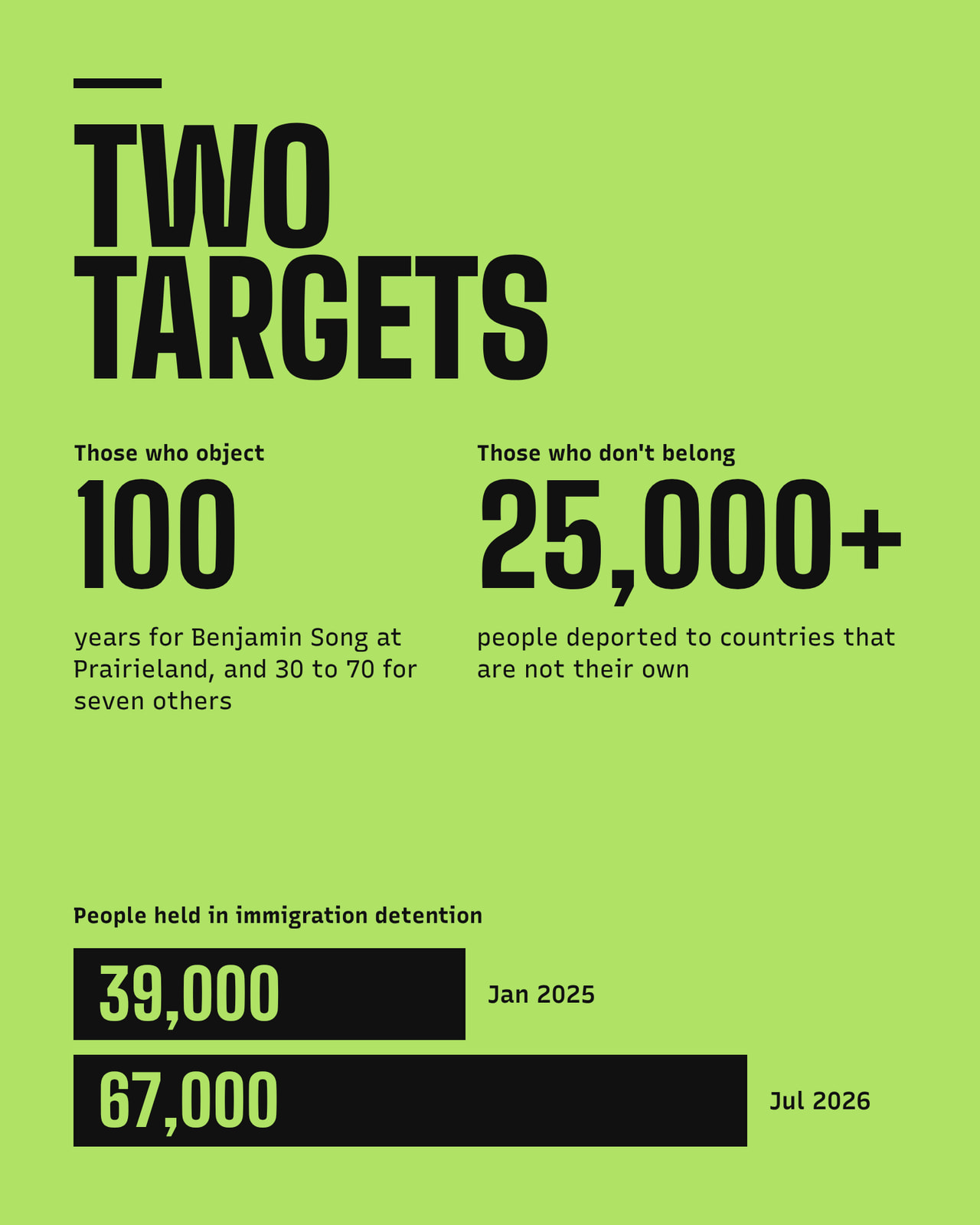
My answer is that it is pointed at two kinds of people. The first are people who object, from protesters to the people who film arrests. The second are people who were never counted as belonging, from migrants to refugees of the wrong origin. And the machine is getting bigger. ICE made more than 50,000 arrests a month in July and August, the first time the agency has reached that level.2 The detention population rose from about 39,000 in January 2025 to 67,000 at the end of July, and Congress has provided $45 billion to expand it further.3
This week supplied one clean case of each.
The Dissent Case
On 4 July 2025, at a protest outside the Prairieland Detention Center in Texas, a police lieutenant was shot. The Justice Department described it as a terrorist attack by an antifa cell.4 Benjamin Song was convicted of attempted murder and sentenced to 100 years. Seven others received sentences of 30 to 70 years, with convictions that included providing material support to terrorists.5 I am not arguing about whether Song fired. He was convicted of it, and a shooting is not dissent.
What makes Prairieland a dissent case is everything around the shooting. The terrorism frame reached seven defendants who were not convicted of the shooting, and it rests on a designation Nineteen Months traced: antifa named a domestic terrorist organization twelve days after Charlie Kirk was killed, followed by a presidential memorandum that court filings describe as directed at groups promoting anti-Americanism, anti-capitalism and anti-Christianity.1 Those are descriptions of belief, not conduct.
The trial also ran on one side's terms. According to The Intercept's account of the record, the judge barred the defense from arguing self-defense. The lieutenant testified that he drew his weapon first, a detail left out of the police report and out of discovery. The defense's ballistics expert asked repeatedly to see Song in federal detention, and approval never came.6 None of that establishes innocence. It establishes that once a protest is framed as terrorism, the defendants enter a room where the protest's context cannot be argued.
The Out-Group Case
Leavenworth, Kansas, did not want an immigration detention hub. When CoreCivic moved to reopen a shuttered maximum-security prison as one, the city fought it in court, CoreCivic countersued, and the Justice Department intervened on the company's side.7 The city spent roughly $820,000 in legal fees, about 6 percent of its general fund, and gave way when officials concluded a takings-clause claim could ruin it. In August the federal government bought the building outright for $238 million, and the city learned of the sale from CoreCivic.7 More than 500 people were held there as of August, in a facility with 1,033 beds, and their cases are heard by video. The immigration attorney Genevra Alberti said ICE uses smaller places because "no one's paying attention.”7
The out-group is being defined in the same weeks it is being detained. The administration told Congress it intends to accept 17,500 refugees in the coming fiscal year, primarily white South Africans.8 The Guardian counts more than 25,000 people deported to countries that are not their own, about 20,000 of them bussed to Mexico by the count of Refugees International and Human Rights First.9 The Solicitor General told the Supreme Court this week that the government "has been able to remove thousands of aliens to third countries in recent months." Those removals have run through more than two dozen countries, often under agreements that have not been made public.10 A deportation to a person's country of origin is a policy the public can argue about. A deportation under an agreement nobody has published is not.
Bigger, and Less Watched
Scale would matter less if oversight grew with it. It is going the other way. In Austin on 20 September an ICE officer shot Wilber Rafael Garcés Pérez, a Venezuelan food delivery driver, after a traffic stop. Homeland Security skipped the news conference and released no details.2 The officer had been issued a body camera and was not wearing it.11 He was taken from an Austin hospital the afternoon of the shooting to a detention center about 140 miles away.12 The Travis County district attorney still did not have the officer's name.13
The money runs ahead of the planning as well. The Government Accountability Office found that ICE has wasted tens of millions of dollars on rushed expansion plans, including tents at Guantanamo Bay removed without housing anyone and warehouses abandoned before they held a single detainee. Without a strategy, it warned, the agency "will likely continue to make uninformed decisions."3 An agency that cannot plan its own spending has been handed $45 billion to expand, and the people it detains are being moved to places where fewer people can see what happens to them.
The Objection
The strongest objection is that this is law enforcement, not targeting. Immigration law is the law, Congress funded the expansion, and a police officer was shot at Prairieland. In Austin, police video shows an earlier stop roughly ten minutes before the shooting, which complicates Garcés Pérez's own account.12
All of that can be true and the pattern still holds. The test of whether a category is being stretched to fit a target is what the enforcement finds when it looks. The whole-of-government hunt for noncitizens on the voter rolls has produced about 160 arrests, against roughly 211 million registered voters.14 That is not a program finding a problem. It is a program built to produce a category of suspect voters, and failing to. Where courts have looked closely they have pushed back: the 1st Circuit halted deportations to third countries this week, and the administration went straight to the Supreme Court.10 The checks are real. They are slower than the machine, and the machine is growing.
Where the Two Meet
The two targets are not separate, and the clearest cases in the record belong to both: the noncitizen who dissents. Mahmoud Khalil was detained in 2025 over campus protest activity, and Rumeysa Ozturk over an opinion piece she co-wrote in a student newspaper.1 This week the administration asked the Supreme Court to overturn the release of the Georgetown scholar Badar Khan Suri, whom a district judge freed after finding his arrest was retaliation for protected speech.15 For a person without citizenship, objecting is now enough to move them from the first group into the second.
One hypothesis is that this is the direction for everyone else: dissent treated as evidence of not belonging. The Prairieland material-support convictions show the terrorism frame already reaches people convicted of no shooting. Whether it spreads depends on what the courts and the midterms do with it, and on whether the people outside both groups decide the machine is their problem too.
Footnotes
15 footnotes, 1 to The Open Record.
- 1
Nineteen MonthsA special release of The Open Record
the first ten weeks was made possible by what was removed in them: the inspectors general, the labor boards, the bodies inside the government able to refuse.
- 2
PBS NewsHour (opens in a new tab)pbs.org
ICE made more than 50,000 arrests a month in July and August, the first time the agency has reached that level.
- 3
PBS NewsHour (opens in a new tab)pbs.org
The detention population rose from about 39,000 in January 2025 to 67,000 at the end of July, and Congress has provided $45 billion to expand it further.
- 4
U.S. Department of Justice (opens in a new tab)justice.gov
The Justice Department described it as a terrorist attack by an antifa cell.
- 5
KERA News (opens in a new tab)keranews.org
Seven others received sentences of 30 to 70 years, with convictions that included providing material support to terrorists.
- 6
The Intercept (opens in a new tab)theintercept.com
The defense's ballistics expert asked repeatedly to see Song in federal detention, and approval never came.
- 7
The Intercept (opens in a new tab)theintercept.com
and the Justice Department intervened on the company's side.
- 8
CNN (opens in a new tab)cnn.com
The administration told Congress it intends to accept 17,500 refugees in the coming fiscal year, primarily white South Africans.
- 9
The Guardian (opens in a new tab)theguardian.com
The Guardian counts more than 25,000 people deported to countries that are not their own, about 20,000 of them bussed to Mexico by the count of Refugees International and Human…
- 10
PBS NewsHour (opens in a new tab)pbs.org
Those removals have run through more than two dozen countries, often under agreements that have not been made public.
- 11
CBS News (opens in a new tab)cbsnews.com
The officer had been issued a body camera and was not wearing it.
- 12
The Guardian (opens in a new tab)theguardian.com
He was taken from an Austin hospital the afternoon of the shooting to a detention center about 140 miles away.
- 13
The Intercept (opens in a new tab)theintercept.com
The Travis County district attorney still did not have the officer's name.
- 14
PBS NewsHour (opens in a new tab)pbs.org
The whole-of-government hunt for noncitizens on the voter rolls has produced about 160 arrests, against roughly 211 million registered voters.
- 15
Reuters (opens in a new tab)reuters.com
This week the administration asked the Supreme Court to overturn the release of the Georgetown scholar Badar Khan Suri, whom a district judge freed after finding his arrest was…